








Separating property, pensions and income
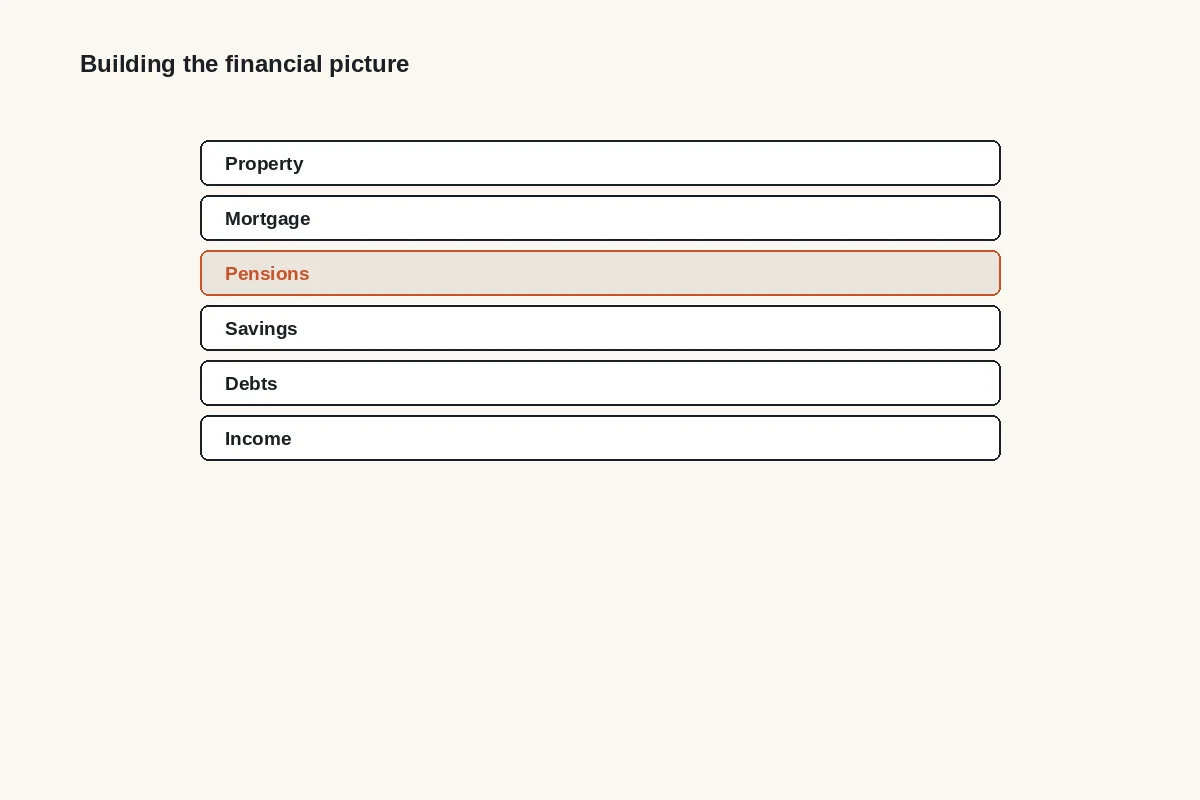
Financial mediation deals with dividing what you built together and deciding how each of you lives afterwards. It covers the family home, other property, pensions, savings, investments, business interests, debts and income. It applies whether you were married, in a civil partnership, or cohabiting, though the legal position differs sharply between those and that difference matters from the first session.
Married couples and civil partners have financial claims against each other that a court can adjudicate under the Matrimonial Causes Act 1973. Cohabiting couples do not. There is no such thing as common law marriage in England and Wales, and a partner who is not on the deeds and made no financial contribution may have no claim on the property at all. People are frequently shocked by this, and it is better to learn it in a first session than after a year of assuming otherwise.
Full disclosure, on both sides

The process runs on the same financial information a court would require. Payslips, tax returns, bank statements, mortgage statements, property valuations, pension statements, and details of any debts. Both of you provide it, both of you see all of it.
This is where mediation has a hard limit, and it is worth stating plainly. A mediator cannot compel disclosure. If one of you will not provide honest information, the process cannot do its job and we will say so rather than continue. A court has powers here that we do not.
The family home

Three routes, and which is realistic is usually decided by a lender rather than by either of you. Sale with the proceeds divided. A buy-out, where one party takes on the mortgage alone. Or a deferred sale, commonly until the youngest child finishes education.
A deferred sale needs its terms written down in detail: who pays the mortgage, who pays for repairs, what happens if the resident party wants to move, what triggers the sale, and how the proceeds are divided when it comes. Deferred arrangements that were agreed loosely become the dispute they were meant to prevent.
Pensions

Often the single largest asset, and the one most frequently overlooked. The cash equivalent transfer value is the starting point. For defined benefit schemes, including most public sector schemes, that value can substantially understate the benefit being given up, and an actuarial report is worth its cost where the sums are large enough to change the settlement.
Pension sharing transfers a percentage into the other party's own name and produces a genuine clean break. Offsetting trades pension value against another asset, most often the house, and it is simpler but it carries a risk that is easy to miss: property and pensions do not grow at the same rate, and a split that looks equal today may not be in twenty years.
Income and maintenance

Child maintenance follows the Child Maintenance Service formula unless you agree otherwise. Spousal maintenance is not automatic and depends on need, on the length of the marriage, and on each party's earning capacity. Where it is agreed, it can be for a fixed term or until a specified event, and it can be capitalised into a lump sum so that neither of you has an ongoing financial tie to the other.
Debt
Debt is dealt with as part of the whole picture rather than separately. Joint debts remain the responsibility of both parties as far as the lender is concerned, regardless of what the two of you agree between yourselves. An agreement that one party will pay a joint loan does not release the other from liability if they stop paying, and that point is worth understanding before it is agreed.
What makes it final
An open financial statement and a memorandum of understanding, converted by a solicitor into a consent order and approved by the court. For married couples this is the only thing that ends future claims. An agreement without an order leaves both of you exposed to a claim years later, including after one of you has remarried or received an inheritance.
Cohabiting couples, and why the position is so different
If you were not married or in a civil partnership, the law provides no financial claims between you on separation. Property is decided by ownership under the Trusts of Land and Appointment of Trustees Act 1996, and by whether a beneficial interest can be established through contributions or common intention.
The practical effect is stark. A partner who is not on the deeds, and who paid no part of the deposit or mortgage, may have no claim on a home they lived in for fifteen years. Claims can be made for children under Schedule 1 of the Children Act 1989, but those are for the child's benefit and generally end when the child does.
This is the single most misunderstood area of family law in England and Wales, and finding out at separation is a bad time to learn it.
Debt, and who the lender actually holds responsible
Joint debts remain joint as far as the lender is concerned, whatever the two of you agree. If your agreement says your ex-partner pays the joint loan and they stop, the lender pursues both of you and your credit file records it.
Where possible the safer route is to separate the debt rather than allocate it: transfer a balance into one name, refinance, or clear it from the sale proceeds. Where that is not possible, the agreement should record what happens if payments stop, so that the risk is at least understood rather than discovered.
Tax, and the timing that costs the most
Transfers of assets between spouses are exempt from capital gains tax in the tax year of separation, and since April 2023 that treatment extends for up to three further tax years, or indefinitely where the transfer is part of a formal divorce agreement. Separating in March and transferring in April can therefore be considerably more expensive than the same transfers a few weeks apart.
Stamp duty land tax can apply to a buy-out where a mortgage is taken over. We are not tax advisers and we do not give tax advice, but we will flag where a decision has a tax consequence so you can take advice before agreeing rather than after.
What a consent order actually does
It records the agreement, it is approved by a judge, and it makes the terms enforceable. A clean break clause ends all future claims between you, including claims on each other's estates. Without it, a claim can be made years later, and remarriage does not close it in every case.
A judge will not simply rubber-stamp whatever is submitted. The court considers whether the agreement is broadly fair given the disclosed circumstances, which is another reason the disclosure has to be complete and accurate.
If circumstances change afterwards
Capital orders are final and are not revisited because someone's situation improved. Maintenance orders can be varied where circumstances change materially. Child maintenance can always be recalculated through the Child Maintenance Service. Knowing which parts of a settlement are fixed and which are not is worth understanding before you agree to it.


 Face to face sessions
 Online and remote mediation
 Evening and weekend appointments