

There is no common law marriage. What that means in practice, and what claims do exist.
The misconception, stated plainly
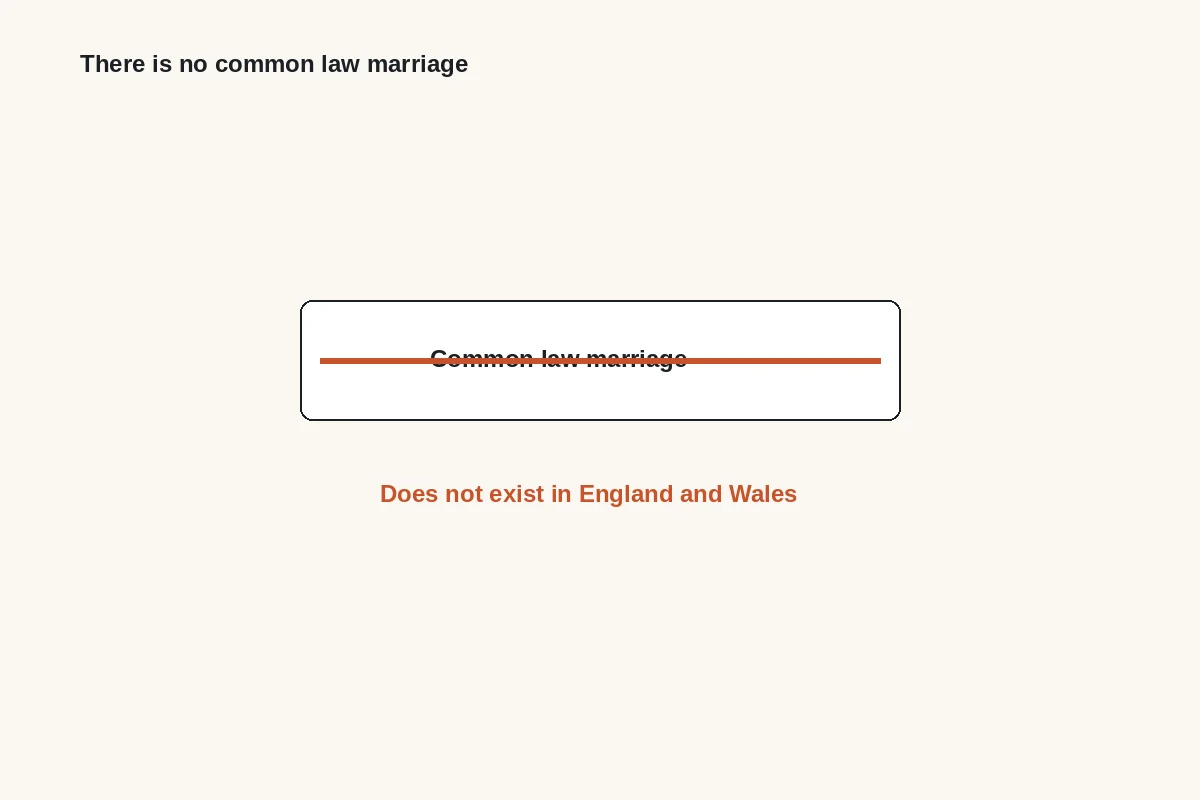
Common law marriage does not exist in England and Wales. It has not existed since 1753. Living together for twenty years, having children together, and sharing every bill creates no financial claim by one partner against the other.
Surveys consistently find that around half of people believe otherwise, and the belief is usually discovered at the worst possible moment. If you are cohabiting and reading this before a separation, the practical advice is to fix the paperwork now rather than to hope.
What actually determines who gets the house
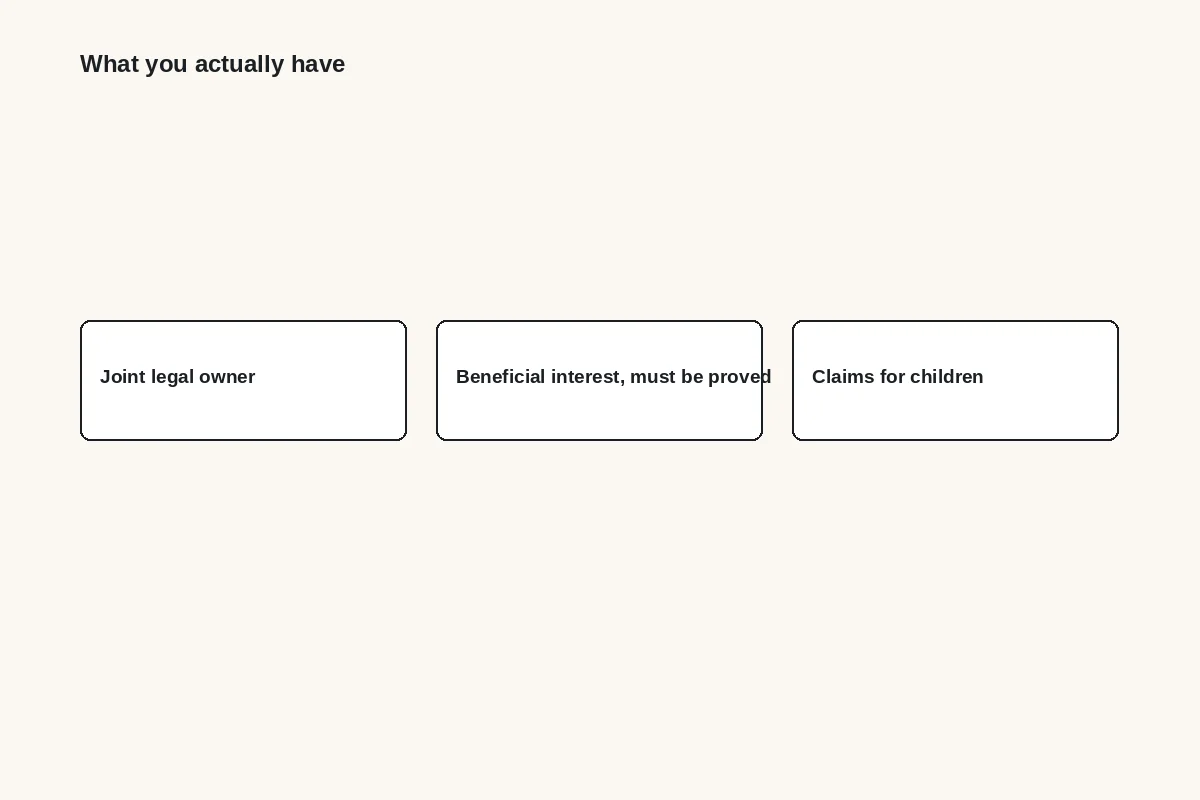
Legal ownership first. If the property is in joint names, you are both owners and the starting point is the declaration of trust made at purchase, if there is one. If there is no declaration, the beneficial shares can still be argued about, but joint legal ownership is a strong position.
If the property is in one name only, the other party must establish a beneficial interest. That means showing either an express agreement, or a common intention inferred from the whole course of dealing, together with detrimental reliance. Direct contributions to the purchase price or the mortgage are the strongest evidence. Paying the household bills, decorating, or raising the children in the property is generally not enough on its own, which people find hard to accept and which is nonetheless the law.
These claims are brought under the Trusts of Land and Appointment of Trustees Act 1996, and they are litigated in the civil courts rather than the family courts. They are expensive and their outcomes are uncertain.
Claims for children
Schedule 1 of the Children Act 1989 allows a parent to apply for financial provision for a child. It can produce a lump sum for a specific need, a property to house the child, or in limited cases periodical payments beyond the Child Maintenance Service calculation.
The critical limitation: the provision is for the child, not the parent. A property provided under Schedule 1 is usually held on trust and reverts to the paying party when the child finishes education. The parent housing the child does not acquire it.
Pensions
No claim. A cohabiting partner cannot share a pension on separation, whatever the length of the relationship. Some schemes pay a death benefit to a nominated partner, which is worth checking and nominating for, but that is a different question from separation.
What mediation can do here

A great deal, and it is often the better route precisely because the legal position is so stark. Two people can agree an outcome that reflects what actually happened between them, whereas a court is limited to what the law provides. Someone with no legal claim can be provided for by agreement, and frequently is.
The mediator will make sure both of you understand the legal starting point before you negotiate, because an agreement made by someone who thinks the law says something else is not an informed agreement.
What to do if you are still together
A declaration of trust setting out the beneficial shares, if you own property jointly or one of you contributed. A cohabitation agreement covering what happens on separation. Wills, because there is no automatic inheritance between cohabitants. And a pension nomination.
Each is inexpensive relative to the dispute it prevents, and each is easiest to arrange when neither of you needs it.
If you have already separated
Take advice quickly. Time limits and the practical difficulty of evidencing contributions both worsen with delay. Gather what evidence you have of financial contributions and of any conversation about ownership, including messages, because a common intention is proved with exactly that kind of material.
There is no common law marriage
It does not exist in England and Wales and it has not for a very long time. Living together for twenty years, having children together, and being described by everyone as a couple gives you no automatic claim on anything in the other person's name.
Surveys consistently find that a large share of cohabiting adults believe otherwise, and the belief is usually discovered to be wrong at the worst possible moment. It is the most consequential misunderstanding in family law.
What you actually have
Your rights come from property law and from the law relating to children, not from family law's discretionary powers.
If you are a joint legal owner of the property, you own it, and the starting point is the shares stated in the transfer deed. If the deed declared a beneficial split, that declaration is generally conclusive.
If the property is in the other person's sole name, you own nothing unless you can establish a beneficial interest, which is a legal argument requiring evidence rather than an entitlement.
If you have children together, you can claim for them. That is a genuine and often overlooked right.
Establishing an interest in a property you do not legally own
The route is a claim under the Trusts of Land and Appointment of Trustees Act 1996, arguing a common intention constructive trust. In outline, you must show a shared intention that you would have an interest and that you acted to your detriment in reliance on it.
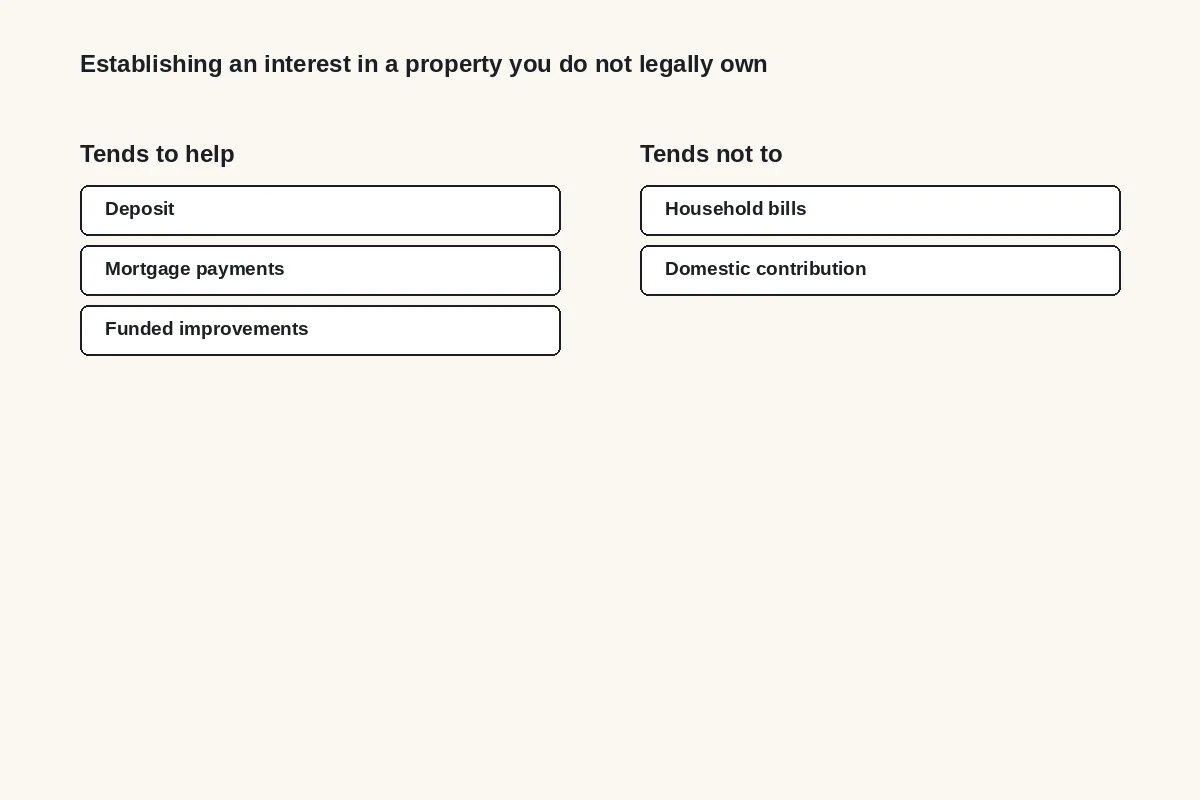
What tends to support such a claim: contributing to the deposit, paying the mortgage, funding substantial improvements that added value, and evidence of what was said and understood at the time.
What tends not to: paying the household bills, doing the cooking, giving up work to raise children, and general contribution to family life. This strikes many people as unjust and it is nonetheless the law. The leading cases are clear that domestic contribution alone does not create a property interest.
These claims are expensive, evidentially demanding and uncertain. Anyone contemplating one should take advice on the merits before spending money on it.
Claims for children, which are stronger than people expect
Schedule 1 to the Children Act 1989 allows a parent to claim financial provision from the other parent for a child, whether or not the parents were ever married.
The court can order a lump sum, a property transfer or a settlement of property for the child's benefit, and in higher income cases a carer's allowance within child maintenance.
The important limit is that provision is for the child and generally lasts only while the child is dependent. A property settlement typically reverts to the paying parent once the child finishes education. It houses the child, it does not transfer wealth to the other parent.
Even so, for a cohabitant with children and no property interest, Schedule 1 is frequently the most substantial claim available, and it is routinely missed.
Child maintenance
Handled by the Child Maintenance Service on a formula based on the paying parent's gross income, the number of children and the nights they spend with each parent. Marriage is irrelevant to it.
Most parents are better served by a family based arrangement agreed directly, which avoids the service's fees and can be more flexible. The formula is published and you can calculate it yourself before agreeing anything, which is worth doing so that the figure you agree is an informed one.
Pensions, inheritance and death
You cannot claim a share of a cohabitant's pension on separation. There is no equivalent of a pension sharing order.
If your partner dies without a will, you inherit nothing under the intestacy rules however long you lived together. A cohabitant may bring a claim under the Inheritance (Provision for Family and Dependants) Act 1975, which requires living together as if married for two years before the death, and it is a claim rather than an entitlement.
Check the death in service nomination with your partner's employer and the expression of wish on their pension. These are frequently out of date and they are quick to fix.
Make a will. For an unmarried couple it is not administrative housekeeping, it is the difference between provision and nothing.
Practical steps if you are separating now
Obtain the title register from HM Land Registry so you know who legally owns what. It costs a few pounds.
If you are a joint owner, consider registering a restriction. If you claim a beneficial interest in a property in the other person's sole name, you can protect it by registering a unilateral notice, which prevents a sale completing without your claim surfacing. Take advice before doing this, because it has consequences.
Gather the evidence of your contributions now: bank transfers for the deposit, receipts for the extension, messages discussing what was agreed. Evidence gets harder to assemble with every month that passes.
Deal with joint debts. Joint liability on a loan or a credit account survives the relationship entirely.
Mediation for cohabiting couples
It works, and it is often a better fit than for married couples, because the alternative is civil litigation rather than family proceedings. TOLATA claims are conducted under the civil costs rules, where the losing party usually pays the winner's costs. That risk is severe and it is the reason a negotiated outcome is so often the sensible one.
Mediation can address the property, the children, the debts and the practical separation in one process, and it can produce an agreement recorded in a separation deed drawn up by solicitors, which is enforceable as a contract.
Where there are children, a resulting agreement can also be put into a consent order under Schedule 1, giving it the force of a court order.
If you are still together
A cohabitation agreement, and a declaration of trust recording the shares in which you hold the property. Both are inexpensive and both remove almost every argument described above.
They are uncomfortable conversations to have with someone you live with. They are far less uncomfortable than the alternative conversation, which happens with solicitors present.
How Mediation Direct can help in Hartlepool
Approach divorce with clarity. Resolve property property division, pensions, child living schedules, and parenting arrangements through structured discussion.
Frequently Asked Questions About Our Services in Hartlepool
We lived together fifteen years. Does that give me rights?
No. Length of cohabitation creates no financial claim in England and Wales. There is no common law marriage at any duration.
I paid the bills while they paid the mortgage. Do I have a share?
Paying household bills is generally not enough on its own. Direct contributions to the purchase or mortgage are much stronger evidence of a beneficial interest.
Can I claim maintenance for myself?
No. There is no spousal maintenance equivalent for cohabitants. Claims under Schedule 1 are for the child's benefit.
What happens to the house if it is in their name?
You would need to establish a beneficial interest through contributions or a common intention with detrimental reliance, under TOLATA. It is a civil claim and it is expensive.
Do I have a claim on their pension?
No. Cohabiting partners cannot share pensions on separation. Check any death benefit nomination separately.
Does having children change the position?
It creates claims for the children under Schedule 1, and child maintenance. It does not create claims for you.
Is mediation useful if I have no legal claim?
Often more useful, because the two of you can agree an outcome the law would not provide. The mediator will make sure you both understand the starting point first.
What is a declaration of trust?
A document recording the beneficial shares in a property. If you own jointly or one of you contributed unequally, it is the single most useful thing you can put in place.
Would a cohabitation agreement be binding?
They are generally upheld where both parties took independent advice and disclosed their finances, though they are not given the automatic weight a consent order has.
Is the law going to change?
Reform has been recommended repeatedly and not enacted. Plan on the basis of the law as it is.
About the author

Authored and reviewed by Family Mediation Council (FMC) accredited family mediators. Every procedural timeline and statutory requirement is verified against the Family Procedure Rules 2010 Part 3 and current Ministry of Justice standards.
- FMC Accredited
- Standards Board Registered
- Authorised MIAM Provider
- MoJ Voucher Scheme
Talk to someone who knows Hartlepool
No obligation, and nothing is decided on the call. We will talk through where you are and what your options actually are.