

Achieving permanent financial independence after divorce and protecting your future earnings and assets.
What a clean break order does
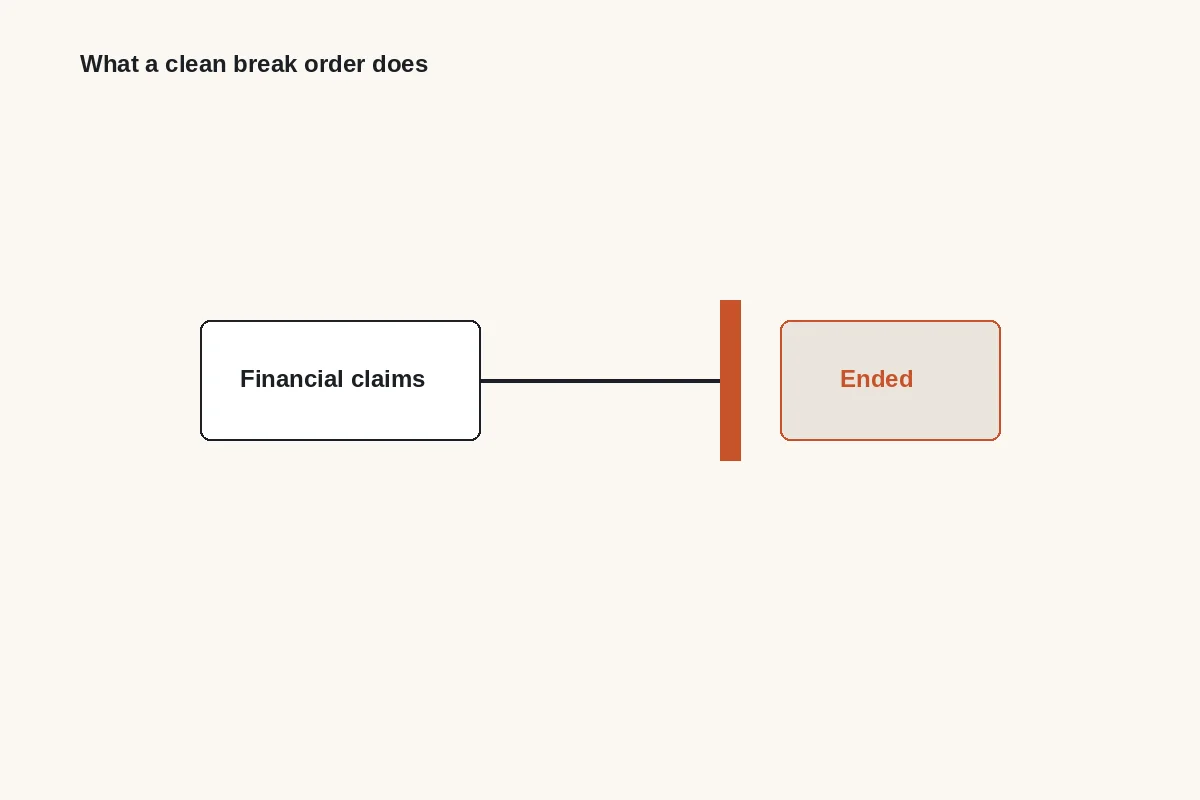
A clean break order ends all financial claims between two people permanently. Neither can later apply for maintenance, a lump sum, a property transfer, or a share of the other's pension. It also dismisses claims against each other's estates on death.
Without one, those claims survive the divorce itself. This is the point most people find surprising: the final order of divorce ends the marriage and does nothing to the financial relationship. A claim can be brought years afterwards, and the fact that you both moved on and considered it settled is not a defence.
Why the divorce alone does not protect you
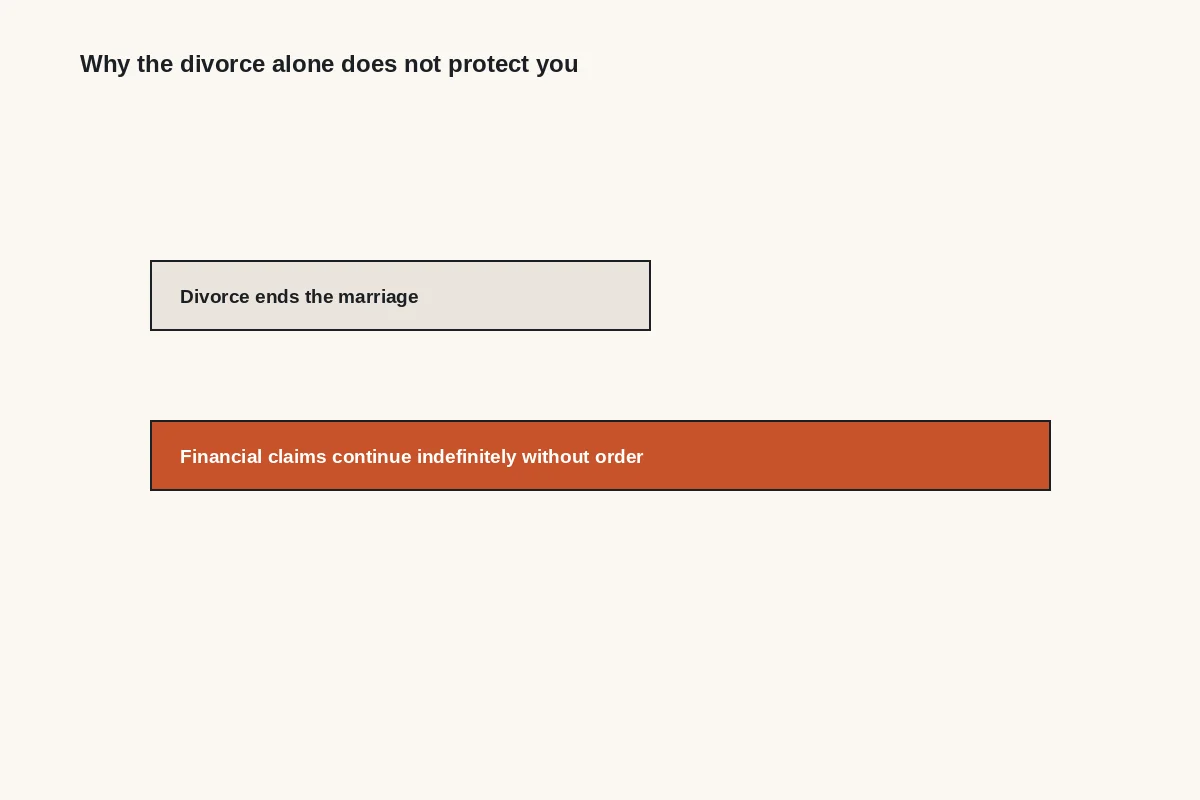
There are reported cases of claims succeeding decades after separation, where no financial order had ever been made. A person who built a business, received an inheritance, or won a substantial sum after separating found the claim was still open because nothing had ever dismissed it.
If the two of you have agreed everything and there is nothing left to divide, that is precisely the situation in which a clean break order is easiest to obtain and most worth having.
Immediate and deferred
An immediate clean break ends all claims from the date of the order. It suits couples with no children, no maintenance obligation, and no assets requiring ongoing arrangement.
A deferred clean break allows spousal maintenance for a defined period and ends all claims when it stops. It is used where one party needs time to re-establish an income, commonly after a long marriage or where they had the greater share of childcare. The order specifies the end date and states that no application to extend the term can be made, which is a specific provision under section 28(1A) of the Matrimonial Causes Act 1973 and is easy to omit by accident.
What a clean break does not end

Child maintenance. It cannot be dismissed by agreement, because it belongs to the child rather than to either parent. The Child Maintenance Service retains jurisdiction regardless of what any order says, and either parent can apply at any time.
Arrangements for the children are also unaffected. A clean break is financial only, and it says nothing about where the children live or who they see.
Getting one
You need a financial agreement, disclosure that supports it, and a solicitor to draft the consent order. The order is filed with a statement of information summarising both parties' finances, and a judge considers whether the agreement is broadly fair given what has been disclosed.
A judge can refuse. Approval is not automatic, and the most common reason for rejection is an agreement that leaves one party with needs that are clearly unmet while the other retains substantially more. Complete disclosure is what allows the court to approve it.
Where a clean break is not appropriate
Where one party will need maintenance for an indefinite period, typically after a long marriage where one partner has no realistic earning capacity. Where there are pension arrangements that cannot be implemented immediately. Where a deferred property sale means one party retains an interest that has not yet crystallised.
In those cases the order deals with the assets and leaves specific claims open, and it should say precisely which. An order that is silent about a claim is not the same as one that dismisses it.
Timing, and the mistake worth avoiding
Apply for the consent order before applying for the final order of divorce. If one party dies after the final order but before the financial order, the survivor may lose pension benefits that would have been payable had they still been married. It is uncommon and it cannot be undone.
Cost
Drafting a consent order generally costs between 500 and 900 pounds plus the court fee. Against the cost of a claim brought fifteen years later, it is the cheapest protection available in family law, and the one most often skipped because the agreement already feels finished.
What the order actually contains
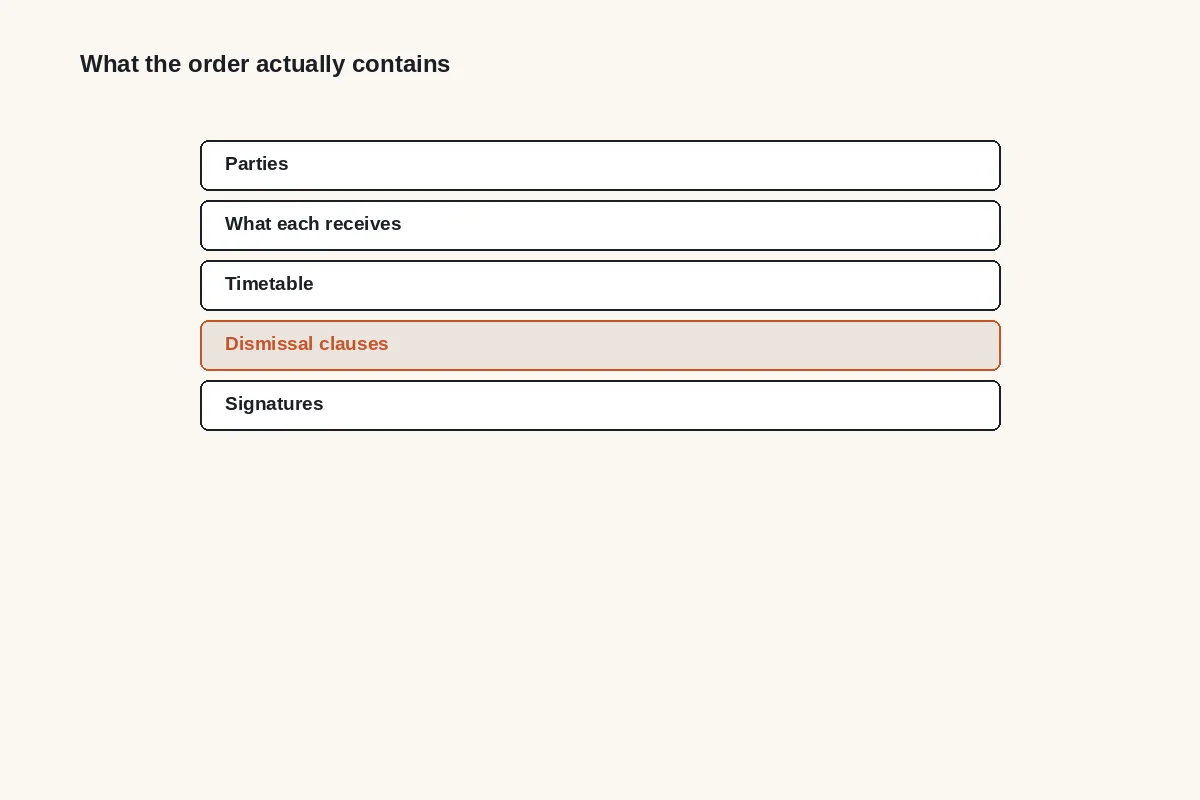
A consent order with a clean break is a short document with a specific structure. It records the parties and the divorce proceedings. It sets out what each party receives: the property transfer, the lump sum, the pension share, the division of savings. It states the timetable for each step. And it contains the dismissal clauses that end future claims.
The dismissal clauses are the operative part and they are easy to get wrong. They must dismiss claims for periodical payments, secured provision, lump sums, property adjustment, pension sharing and pension attachment, and claims against the estate under the Inheritance (Provision for Family and Dependants) Act 1975. An order that omits one of these leaves that claim alive.
The statement of information
The order is filed with a Form D81, a statement of information summarising both parties' finances. It is short and it matters: the judge decides whether the agreement is broadly fair on the basis of what it says.
Both parties sign it. Signing a statement that understates an asset is a false statement to the court, and it is the most common route to an order being set aside years later.
When a judge refuses
Approval is not automatic and refusals happen. The most common reasons are an agreement that leaves one party with obviously unmet needs while the other retains substantially more, a settlement that appears to disregard a significant asset, and a statement of information that is internally inconsistent.
A refusal is usually accompanied by a query rather than a rejection, and it can normally be answered. It adds weeks rather than ending the process.
Deferred clean breaks in practice
Where spousal maintenance is agreed for a term, the order specifies the end date and, critically, whether the term can be extended. Under section 28(1A) of the Matrimonial Causes Act 1973 the court can bar an application to extend, and that bar has to be stated expressly. An order that is silent leaves the paying party exposed to an application years later.
The term is usually tied to a real event: the youngest child finishing education, the recipient completing training, or a fixed number of years. Whichever is chosen, the order should say what happens if that event occurs earlier or later than expected.
Capitalising maintenance
Rather than paying maintenance for a term, the paying party can pay a lump sum representing its capitalised value. This produces an immediate clean break and it appeals to both sides for different reasons: certainty for one, independence for the other.
The calculation uses actuarial tables and it is not simply the monthly figure multiplied by the number of months. Where the sums are large enough to change the settlement, the calculation is worth doing properly.
Setting an order aside
Consent orders are final and the grounds for reopening them are narrow. Material non-disclosure is the main one, and the case law is not sympathetic to a party who concealed an asset. Fraud, undue influence, and a supervening event that fundamentally undermines the basis of the order are the others, and the last is interpreted strictly.
The practical lesson is the one that runs through the whole process: disclose fully. Whatever is being protected is almost never worth the exposure of an order set aside a decade later with costs consequences.
If you have already divorced without one
You can still apply. There is no time limit on applying for a financial order after divorce, though delay weakens a claim and remarriage bars the party who remarried from applying for most forms of relief.
If you divorced years ago and never obtained a financial order, it is worth taking advice now rather than assuming the passage of time has settled it. It has not.
What to check before you sign
Read the recitals as carefully as the orders. The recitals record the basis on which the agreement was reached, including undertakings that are not themselves orders, and they are frequently where a misunderstanding hides.
Check every figure against your own records rather than assuming the drafting picked them up correctly. Transposed digits in an account number or a lump sum are not rare.
Check the timetable. Every obligation should have a date or a defined trigger, and every date should be one that is actually achievable given what has to happen first.
Check what happens if an obligation is not met. A well drafted order says what follows if a property is not sold by a date or a lump sum is not paid, so that non compliance has an answer built into it rather than requiring a fresh application.
After the order is sealed
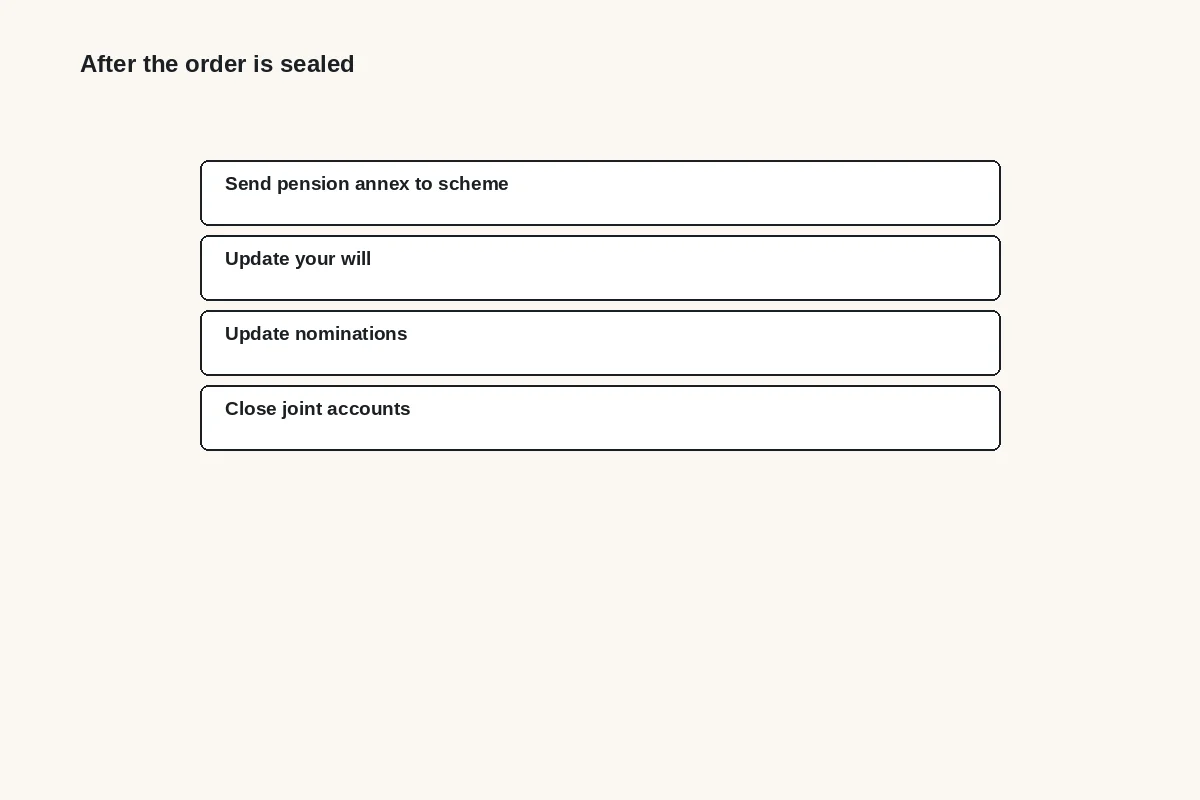
Send the pension sharing annex to the scheme promptly. The scheme has four months from receipt of the order and the annex to implement, and the clock does not start until it has both.
Update your will. A divorce affects the operation of an existing will and the outcome is rarely what the person intended.
Update every nomination: death in service, pension expression of wish, life policies. These pass outside the estate and they are not touched by the order.
Close the joint accounts, cancel the joint credit facilities and remove the financial associations from your credit file. A joint account left open keeps the two of you linked on both files indefinitely.
Common drafting points that cause trouble later
A lump sum with no payment date, or a date with no consequence attached to missing it. A property transfer that does not say who bears the conveyancing cost or the mortgage redemption charge. A pension share expressed as a sum of money rather than as a percentage, which the scheme cannot implement. And an order that deals with the family home in detail and says nothing about the contents.
None of these is complicated to get right and each of them is a reason people find themselves back in front of a court on a point they thought was settled. A solicitor drafting from a properly detailed memorandum will cover them as a matter of routine, which is a large part of why the memorandum is worth taking care over.
How Mediation Direct can help in Hartlepool
Approach divorce with clarity. Resolve property property division, pensions, child living schedules, and parenting arrangements through structured discussion.
Frequently Asked Questions About Our Services in Hartlepool
Do we have to attend court for a clean break order?
No. When agreed through mediation and drafted by solicitors, consent orders are reviewed administratively by a judge in chambers with zero court appearances.
Can a clean break be achieved if we have children?
Yes. A capital clean break dismisses spousal maintenance and property claims while child maintenance continues under statutory Child Maintenance Service (CMS) rules.
What happens if we divorce without a clean break order?
Financial claims remain open indefinitely. Either former spouse can make claims against future earnings, business success, or inheritances decades later.
How long does it take for the court to approve a consent order?
Courts generally process administrative consent orders within 2 to 6 weeks from submission by your solicitor.
What is Form D81 in clean break consent orders?
Form D81 is the official statement of financial information submitted alongside the draft order to state both parties' current financial positions.
Can a clean break order be overturned in future years?
Consent orders are final and binding, unless one party committed fraud, deliberate non-disclosure, or extreme misrepresentation during financial disclosure.
What should we check before signing the order?
The recitals as carefully as the orders, since they record the basis of the agreement and are where a misunderstanding usually hides. Every figure against your own records. That each obligation has a date or a defined trigger, and that the order says what follows if one is not met.
What has to be done after the order is sealed?
Send the pension sharing annex to the scheme promptly, since the four month implementation period does not begin until it has both that and the order. Update your will and every nomination, including death in service and pension expression of wish. Close joint accounts and remove the financial associations from your credit file.
Can maintenance be replaced with a single payment?
Yes. The paying party can pay a lump sum representing the capitalised value of the maintenance, producing an immediate clean break. The calculation uses actuarial tables rather than simply multiplying the monthly figure, and where the sums are large enough to change the settlement it is worth doing properly.
What are the common drafting errors?
A lump sum with no payment date, a property transfer silent on who bears the conveyancing and redemption costs, a pension share expressed as a sum of money rather than a percentage, which the scheme cannot implement, and an order dealing with the house in detail while saying nothing about the contents.
About the author

Authored and reviewed by Family Mediation Council (FMC) accredited family mediators. Every procedural timeline and statutory requirement is verified against the Family Procedure Rules 2010 Part 3 and current Ministry of Justice standards.
- FMC Accredited
- Standards Board Registered
- Authorised MIAM Provider
- MoJ Voucher Scheme
Talk to someone who knows Hartlepool
No obligation, and nothing is decided on the call. We will talk through where you are and what your options actually are.