

Practical frameworks for co-parenting schedules, holiday handovers, and child-focused communication.
What a parenting plan is
A written record of how you will raise your children across two homes. It is not a legal document by itself and it is not filed anywhere. It is the reference both of you return to when a Tuesday goes wrong, and its value is entirely in how specific it is.
The term now widely used is our child's plan, which reflects the shift the document is meant to make: from an agreement between two adults to a description of a child's life.
Term time

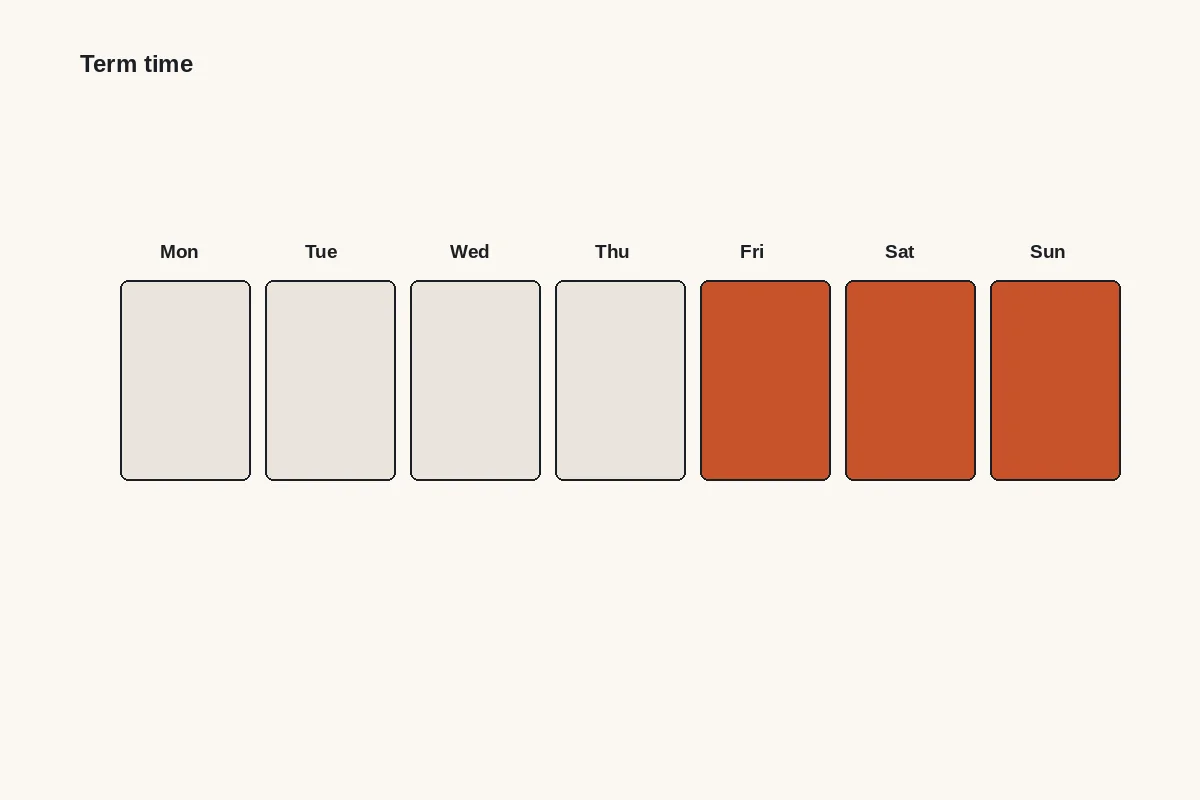
Name the days and the times. Alternate weekends from Friday after school to Sunday at 6pm is a plan. Regular weekend contact is an argument waiting to happen. Include the midweek arrangement if there is one, and say whether it is an overnight or an evening.
Say who does the collection and where. School gate, home address, or a neutral location. If a handover has ever been difficult, a school handover removes the two of you from the doorstep entirely and children rarely notice it as a handover at all.
School holidays

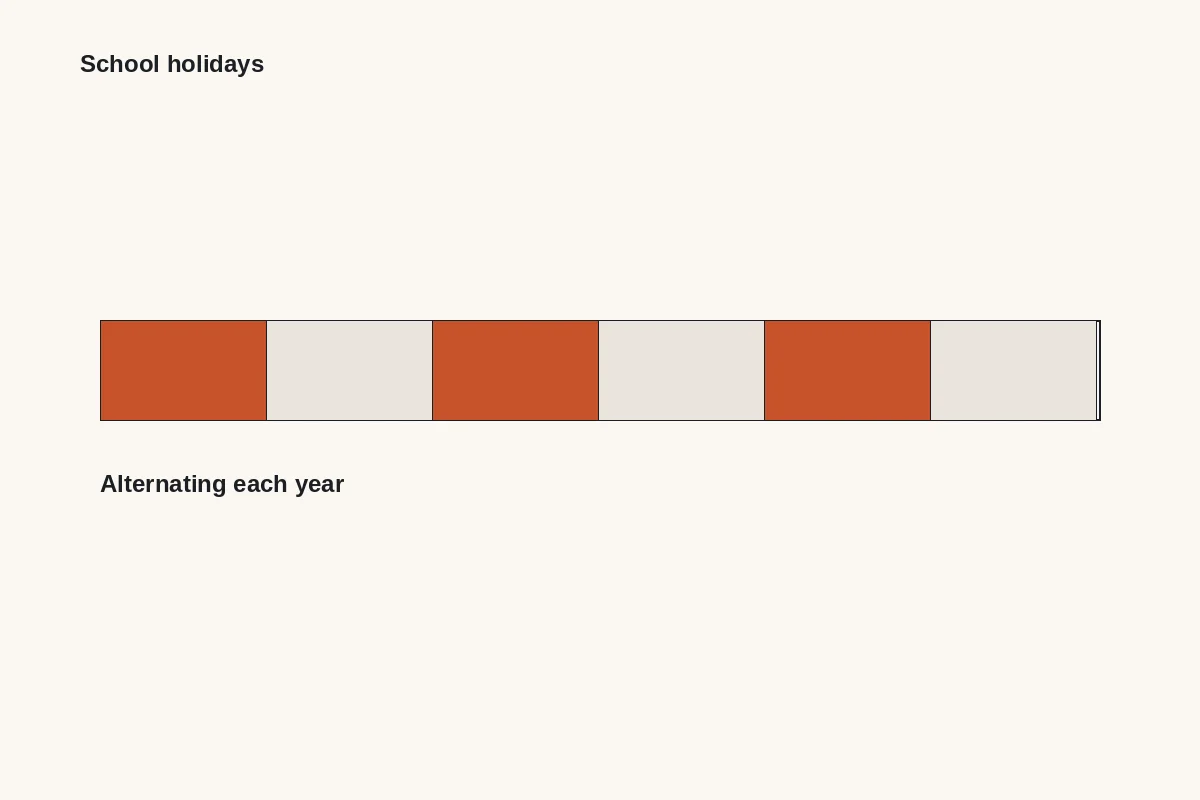
Holidays need their own section because a term time pattern does not scale to six weeks. Most families divide the summer into blocks of one or two weeks and alternate them, with a deadline for confirming dates. A rule that summer dates are exchanged by the end of April prevents the annual argument about who booked first.
Half terms are commonly alternated. Christmas is the one people care most about and the one worth writing in the most detail: name whether the child is with each parent on Christmas Eve, Christmas Day and Boxing Day, and whether that alternates each year.
Birthdays and special days
The child's birthday, each parent's birthday, Mother's Day and Father's Day, and any religious or cultural dates that matter to your family. These are short entries and they prevent disproportionate distress.
Communication between the two of you
Agree the channel and the expectation. Many separated parents use a shared app or a single email thread rather than text messages, because it keeps arrangements in one searchable place and reduces the volume of exchange. Agree what counts as urgent and how you will reach each other for it.
Agree what gets shared: illness, school reports, parents' evenings, medical appointments, and anything a school asks a parent to sign. Most disputes about information are about neither parent knowing they were expected to pass something on.
Communication with the children
Phone or video contact with the other parent while the children are with you. Say when, and say that it is private. A child who feels watched during a call stops making them.
Decisions, and which need both of you
Day to day decisions are made by the parent the child is with. Significant decisions need both: choice of school, non-urgent medical treatment, changing a child's surname, taking a child abroad, and religious upbringing. Write down which decisions you consider significant, because people's assumptions differ and discovering that mid-dispute is the worst time.
Travel
Both parents with parental responsibility must consent to a child being taken abroad, or a court order is needed. Taking a child abroad without that is child abduction and it is a criminal offence. Agree how much notice is given, what details are shared, and who holds the passport.
New partners
An uncomfortable section and a valuable one. Many parents agree a period before a new partner is introduced to the children, and agree that the other parent is told beforehand rather than hearing it from the child. It does not need to be restrictive to be useful.
Reviewing it
Write in when you will look at it again. Annually, or at each change of school, works for most families. A plan built for a five year old does not fit an eleven year old, and a scheduled review makes changing it an ordinary event rather than a confrontation.
Making it legally binding
You do not have to. Most families never do, and a well written plan that both parents follow needs no court involvement. Where you want it enforceable, a solicitor can convert the mediated agreement into a consent order under the Children Act 1989, and a judge will approve it if it is in the child's best interests.
Handovers, in detail
Handovers are where more parenting plans fail than anywhere else, because they are the one moment the two of you have to be in the same place while feelings are still raw.
A school handover removes it entirely: one parent drops off, the other collects. The children do not experience it as a handover at all, which is the strongest argument for it. Where school timing does not work, a neutral public place is the next best, and a doorstep is the hardest.
Write down who travels. A rule that the receiving parent collects is simple and it distributes the burden evenly across the week. Write down what happens if someone is late, and what counts as late. Fifteen minutes of unexplained waiting turns into a grievance quickly, and a sentence agreed in advance prevents it.
Belongings
Small and constant. School uniform, PE kit, the coat, the instrument, the medication, the comfort toy. Agree whether the child travels with a bag or whether each home holds a full set.
Two full sets is easier and it costs money. A travelling bag is cheaper and it puts the child in the position of remembering. For younger children a written list taped inside the bag lid solves most of it.
Illness
Agree in advance who collects a sick child from school on which days, and whether a child who is unwell stays where they are rather than travelling. A feverish child moved between houses because it is Friday is the clearest example of a plan serving the adults rather than the child.
Homework, screens and rules
Two homes will not run identically and they do not need to. What matters is that the significant things are consistent: bedtime on a school night, whether homework is done before screens, and the general position on phones and social media.
Where you genuinely disagree, say so in the plan rather than pretending. A child who knows the rules differ between houses copes with that easily. A child caught between two parents each insisting their rule is the real one does not.
Extracurricular activities
Who takes the child to Saturday football, who pays for it, and what happens when it falls in the other parent's time. Activities are one of the most common flashpoints because they cut across the schedule every single week.
The default that works for most families is that the parent whose time it is takes the child, and the cost is shared. Where one parent is not willing to do the Saturday run, that is worth knowing before it is written down rather than after.
Holidays abroad
Both parents with parental responsibility must consent, or a court order is needed. Taking a child abroad without that is child abduction and it is a criminal offence, regardless of how the family understands the arrangement.
Agree the notice period, what details are shared, and who holds the passport between trips. A passport held by one parent and released on request is common and it needs a written rule about how much notice a request needs.
Reviewing and changing it
Build a review date in, and treat it as ordinary. Annually, or at each change of school, suits most families. A plan that can be revisited without a confrontation is a plan people follow.
Agree how a change is proposed between reviews. A simple rule, such as any change being put in writing at least two weeks in advance, stops small adjustments becoming disputes.
When the plan stops working
Most plans need adjusting within the first year, and needing to adjust one is not a failure. A single mediation session to revisit a plan costs a fraction of what it cost to build, because the ground has been covered once already.
What does not work is one parent unilaterally changing the arrangement and waiting to see whether the other objects. That is how a workable plan becomes a court application.
Communication between the two households
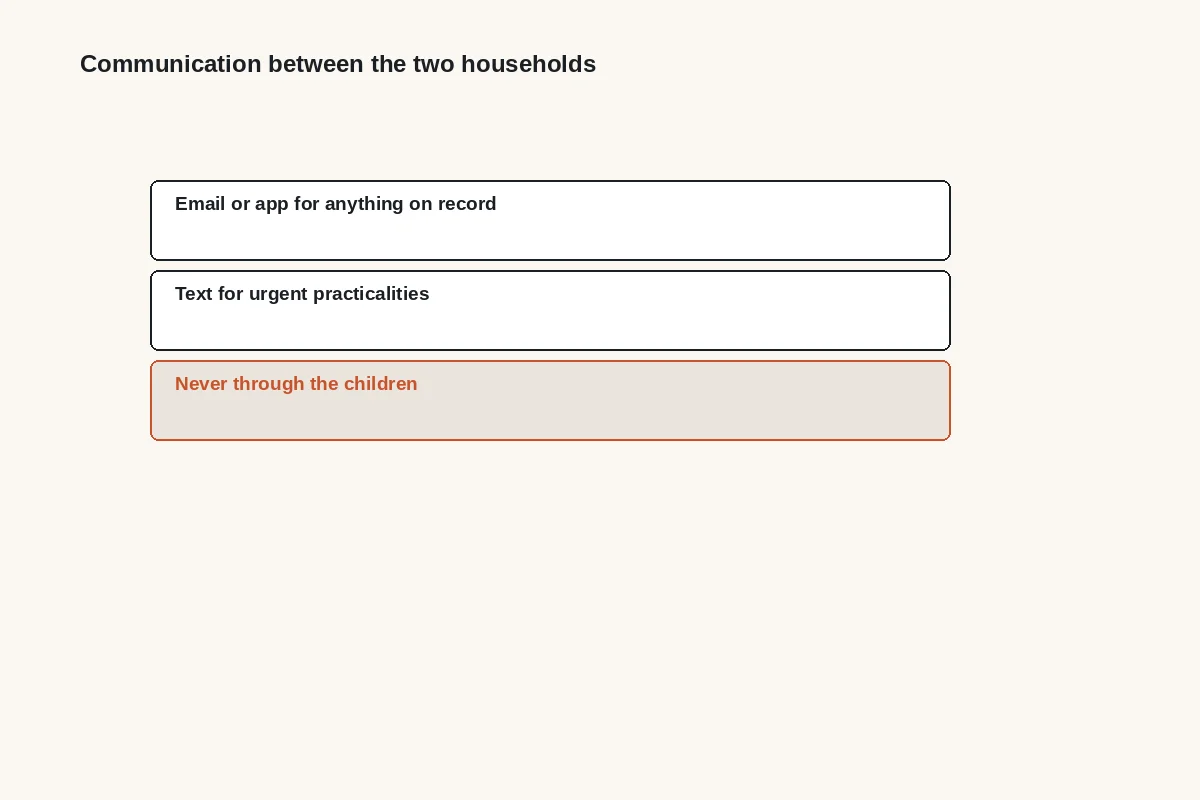
Decide the channel and stick to it. Email or a co-parenting app for anything that needs a record, text for genuinely urgent practicalities, and phone calls only where both of you agree they help. Mixing channels is how a message gets missed and how a missed message becomes evidence of something it was not.
Agree a response time. Forty eight hours for ordinary matters is a common standard and it stops the expectation of an immediate reply, which is where most co-parenting conflict starts.
Agree what the children are told about the communication, which is ideally nothing. A plan that works is invisible to them.
Writing it so it can be relied on
Be specific about times and places. "Alternate weekends" is not specific. "From after school on Friday until Monday morning drop off, on the first and third weekend of each month" is.
Cover the exceptions before they happen: what takes priority when a holiday falls in the other parent's weekend, what happens when a weekend is missed, and whether missed time is made up or simply passes.
Date the plan and sign it. It is not a court order and it is not directly enforceable, and it still carries real weight: a court asked to decide later will want to know what the parents themselves agreed, and a dated document signed by both of you answers that question in a way that recollection does not.
How Mediation Direct can help in Hartlepool
A written record of how the week actually works, agreed at a calm moment rather than at a doorstep.
Frequently Asked Questions About Our Services in Hartlepool
Can a parenting plan be updated as our child gets older?
Yes. Parenting plans are living documents designed to evolve as children progress through primary and secondary education. Parents can return for a short review session whenever adjustments are needed.
What if one parent fails to follow the plan?
While voluntary, a parenting plan can be formalised into a Consent Order by a family solicitor if legal enforceability is required.
How specific should holiday schedules be in the plan?
Plans should specify exact pickup and return times, handover locations, and how school holidays are rotated annually.
Does the parenting plan cover international holiday travel?
Yes. Plans typically outline notice periods, passport custody rules, and flight itinerary sharing for overseas trips.
Can new partners be addressed in the parenting plan?
Yes. Parents often include agreed protocols regarding when and how new partners are introduced to children.
How does child-inclusive mediation assist in drafting the plan?
Consulting children aged 10 and above ensures their views on school routines and hobbies are considered before finalising the plan.
What should the plan say about handovers?
Where they happen, who travels, and what happens if someone is late. A school handover removes the moment entirely, since one parent drops off and the other collects, and the children do not experience it as a handover at all. Where that is not possible, a neutral public place works better than a doorstep.
How do we handle a child being unwell?
Agree in advance who collects a sick child from school on which days, and whether a child who is unwell stays where they are rather than travelling. A feverish child moved between houses because it is Friday is the clearest example of a plan serving the adults rather than the child.
Do the rules have to be the same in both homes?
Only the significant ones, such as bedtime on a school night and the general position on phones. Where you genuinely disagree, say so in the plan rather than pretending. A child who knows the rules differ copes with that easily; a child caught between two parents each insisting their rule is the real one does not.
How should we communicate about the children?
Choose one channel and stay on it, with a shared calendar or a co-parenting app for anything needing a record. Agree a response time, since forty eight hours for ordinary matters removes the expectation of an immediate reply. Never use a child as the messenger, not once.
About the author

Authored and reviewed by Family Mediation Council (FMC) accredited family mediators. Every procedural timeline and statutory requirement is verified against the Family Procedure Rules 2010 Part 3 and current Ministry of Justice standards.
- FMC Accredited
- Standards Board Registered
- Authorised MIAM Provider
- MoJ Voucher Scheme
Talk to someone who knows Hartlepool
No obligation, and nothing is decided on the call. We will talk through where you are and what your options actually are.