

Navigating matrimonial home equity, pension Cash Equivalent Transfer Values (CETVs), and mortgage capacity.
Why pensions are the asset that gets missed

A pension is frequently worth more than the equity in the family home, and it is the asset most often left out of an informal agreement. It does not feel like money. It cannot be spent now, it arrives on a statement once a year, and it is easy to treat as belonging to whoever earned it.
Legally it does not. Pensions accrued during a marriage form part of the matrimonial pot regardless of whose name is on them, and in many settlements they are the largest single item.
The valuation, and why the headline figure can mislead
The starting point is the cash equivalent transfer value, which every scheme will provide on request. For a defined contribution pension, the value is close to the real value: it is a pot of investments.
For a defined benefit scheme, including most public sector schemes such as the NHS, teachers, police, armed forces and civil service, the transfer value can significantly understate what is being given up. Those schemes pay a guaranteed, index linked income for life, and the transfer value does not always reflect what buying that income on the open market would cost.
Where a defined benefit pension is a material part of the settlement, a pensions on divorce expert report is worth its cost. It typically runs between 1,000 and 2,500 pounds, and it regularly changes the shape of a settlement by considerably more than that.
Three ways to deal with a pension

Pension sharing
A percentage is transferred into the other party's own name, either into the same scheme or into a new one. It produces a genuine clean break, because neither party depends on the other afterwards. It is the most common approach and generally the cleanest.
Offsetting
One party keeps the pension and the other receives more of another asset, usually the house. It is simpler and it avoids the cost of implementing a share, and it carries a risk that is easy to underestimate: property and pension values do not move together. A split that looks equal today can look very different in twenty years, and the party who took the house has an asset they may have to sell to live on.
Pension attachment
A share of the pension income is paid to the other party when it comes into payment. It is now rarely used, because it does not produce a clean break, it usually ends on remarriage or on the death of the member, and it leaves one party dependent on the other's retirement decisions.
The house, and the three realistic outcomes

Sale and division of the proceeds. A buy-out, where one party takes on the mortgage alone. Or a deferred sale, commonly until the youngest child finishes education, generally by way of a Mesher order.
Which of these is available is a lender's decision rather than yours. Establishing borrowing capacity with a broker before the session where the house is discussed converts a hypothetical conversation into a real one.
Deferred sales, and the terms people forget to write
A deferred sale needs more detail than it usually receives. Who pays the mortgage and who pays for repairs. What happens if the resident party wants to move, or a new partner moves. Exactly what triggers the sale, whether that is the youngest child finishing school, reaching a certain age, or a specific date. And how the proceeds are divided at that point, whether by fixed percentage or by a formula.
Deferred arrangements agreed in general terms become the dispute they were designed to prevent, ten years later and with less goodwill available to resolve it.
Putting the two together
Most settlements trade between them. A common shape is one party keeping a larger share of the housing equity to provide a home for the children, balanced by the other retaining more pension. Whether that is fair depends on the ages of the parties, how long until retirement, and each party's ability to rebuild.
A settlement that gives one party the house and the other the pension can look even and leave one of them with no home and the other with no retirement income. Which of those is worse depends entirely on how old you both are.
Implementation
A pension sharing order takes effect once the final order of divorce is made and the order is served on the scheme. Schemes have four months to implement and frequently charge a fee, sometimes several hundred pounds. Agree who pays it, because an unallocated implementation charge is a common source of a late dispute.
Getting the valuation, step by step
Write to each scheme requesting a cash equivalent transfer value for divorce purposes. Schemes must provide one, generally free of charge once a year, and they have three months to do so though most are faster. Public sector schemes are frequently at the slower end.
Ask at the same time for the scheme's charging schedule for implementing a pension sharing order, because that cost has to be allocated between you and it is easier to agree at the start.
If you have lost track of a pension from a previous employer, the government's Pension Tracing Service will locate the scheme. It is free and it takes minutes.
What the state pension does and does not do
The new state pension cannot be shared on divorce. Contributions made during the marriage stay with the person who made them.
What can matter is a gap in one party's national insurance record, commonly where they were out of work raising children. Checking the record and understanding whether voluntary contributions would improve it is worth doing, because it affects income in retirement and it is invisible in a transfer value.
Choosing between sharing and offsetting
The question is rarely which is fairer in principle and usually which fits the two of you.
Sharing suits a couple who want independence and who are far enough from retirement for the shared fund to grow. It costs an implementation fee and it produces a genuine clean break.
Offsetting suits a couple where one party needs the housing equity now, most often to keep a home for the children, and the other is content to keep their pension. It avoids implementation cost and it carries the risk that the two assets diverge over twenty years.
The mistake is treating a pound of pension as a pound of house. Pension money is taxed on the way out, it cannot be accessed before the minimum pension age, and it is not a substitute for somewhere to live. A straight pound for pound offset generally favours the party keeping the pension, and where the sums are large enough to change the settlement an expert report will say by how much.
Mesher orders, and what they cost the person who stays
A deferred sale keeps the children in the home and it defers a problem. The party who remains is usually maintaining a property they cannot afford to buy outright, unable to release equity, and facing a sale at a point when they may be in their fifties with limited borrowing capacity.
It is often the right answer and it should be chosen with that understood rather than by default. Where it is used, the trigger events, the maintenance obligations and the division formula all need to be written in detail.
Second properties, and businesses
A buy to let brings capital gains tax into the picture and the timing of a transfer matters considerably. A property held in one name that was funded from joint resources is a common source of dispute and it turns on evidence of contribution.
Where one party owns a business, the practical answer in most cases is that it is not sold. Its value is assessed and offset against other assets, which keeps a functioning business intact and gives the other party something they can use.
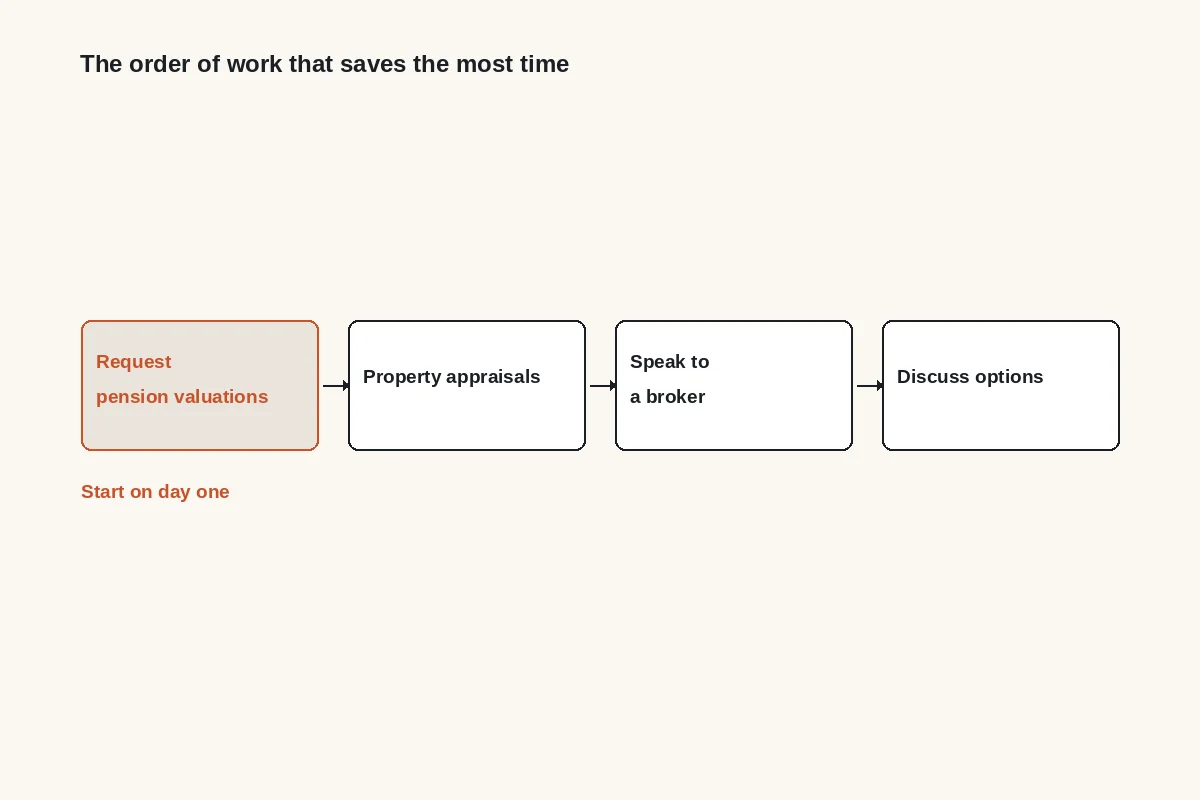
The order of work that saves the most time
Request pension valuations first, before anything else, because they set the pace of the whole case. Get market appraisals for the property while you wait. Speak to a mortgage broker about what each of you could borrow alone. Only then start discussing options.
Couples who follow that order routinely finish a month or more sooner than couples who start with proposals and gather information as questions arise.
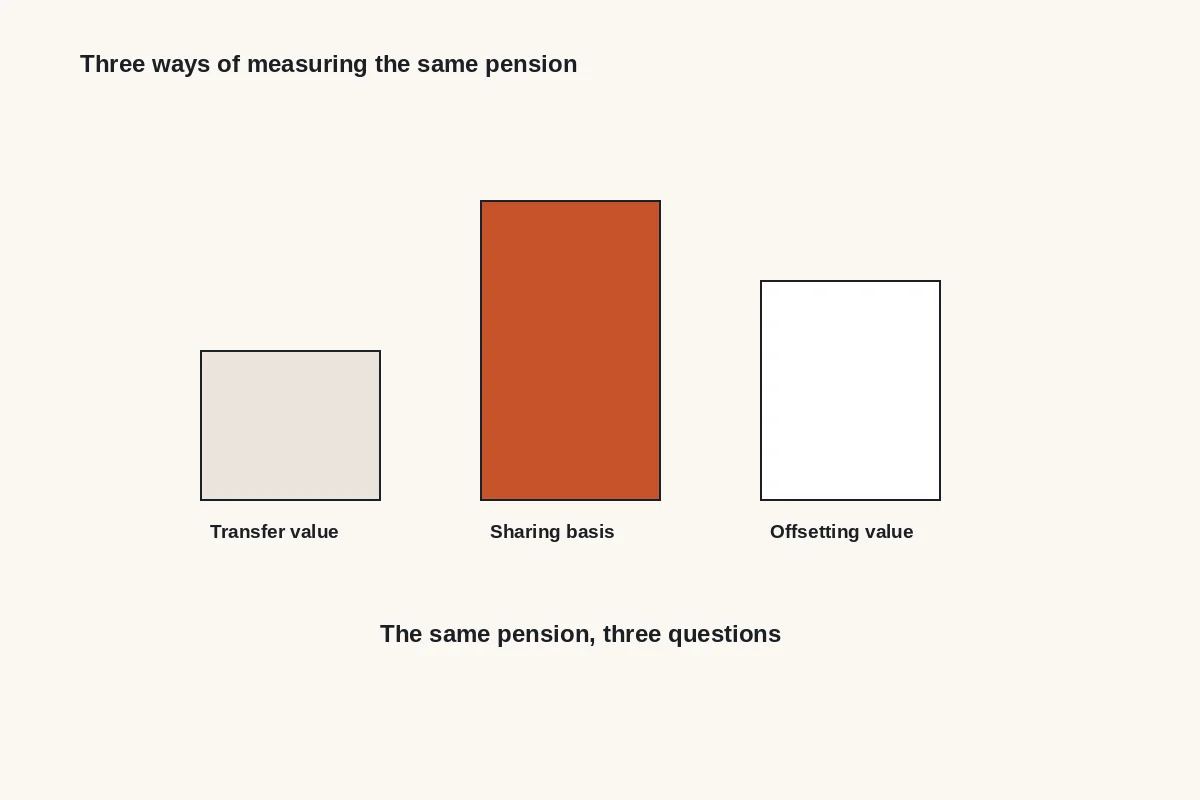
Three ways of measuring the same pension
The confusion in most pension discussions comes from people using different numbers without saying so.
The cash equivalent transfer value is what the scheme says the benefits are worth if transferred out. It is the standard starting figure and, for defined benefit schemes, it frequently understates what the benefits are actually worth to the member.
The value on a sharing basis is what an expert calculates the share needs to be for both parties to receive equal income in retirement. For a defined benefit scheme this is often materially different from an equal split of the transfer value, particularly where the parties are different ages.
The offsetting value is different again, because it has to account for tax on withdrawal and for the fact that pension money cannot be spent now. It is generally lower than the transfer value, sometimes considerably.
Three different questions produce three different numbers from the same pension, and none of them is wrong. An argument that goes in circles is usually two people quoting two of them at each other.
Equalising income rather than capital
Where the parties are close to retirement, the fairer approach is generally to share so that each receives a similar pension income, rather than dividing the capital value equally. Where they are decades away, dividing capital is usually the practical answer because income projections that far out are guesswork.
Which basis is used should be a conscious decision recorded in the memorandum, not something that happens by default because nobody named it.
How Mediation Direct can help in Hartlepool
Separating property equity, pension assets, investments, and debt liabilities obligations with transparent, balanced financial solutions.
Frequently Asked Questions About Our Services in Hartlepool
How do we get a CETV pension valuation?
Each party contacts their pension scheme administrator to request a formal Cash Equivalent Transfer Value (CETV) statement for divorce purposes.
Can one spouse buy the other out of the family home?
Yes, provided the purchasing party secures a mortgage capacity agreement in principle and both parties agree on an independent market valuation.
How long does it take to obtain CETV pension statements?
Pension providers typically take 4 to 12 weeks to produce formal CETV valuation statements, making it vital to request them early in mediation.
Is state pension entitlement included in divorce mediation?
Yes. Both parties can request State Pension forecasts from the Department for Work and Pensions (DWP) using Form BR19 to review entitlements.
What is an actuary report in pension division?
In complex cases involving public sector or defined benefit schemes, an independent actuarial report models equalisation of retirement income.
How is property equity calculated in mediation?
Net equity is calculated by deducting outstanding mortgage balances and early repayment charges from the agreed independent property valuation.
Why do we keep getting different values for the same pension?
Because three different questions are being asked. The transfer value is what the scheme says the benefits are worth if moved. The sharing value is what an expert calculates is needed for both parties to receive equal income. The offsetting value accounts for tax and for the money being inaccessible. None is wrong, and an argument going in circles is usually two people quoting two of them.
What if I have lost track of an old pension?
The government's Pension Tracing Service will locate the scheme from an employer's name. It is free and takes minutes. A forgotten pension from a first job is one of the most commonly missed assets in financial disclosure.
Should we divide the capital or the income?
Where the parties are close to retirement, sharing so that each receives a similar pension income is generally the fairer basis. Where retirement is decades away, dividing capital is usually the practical answer because income projections that far out are guesswork. Whichever is used should be recorded as a conscious decision.
In what order should the information be gathered?
Request pension valuations first, on day one, because they take the longest and set the pace of the whole case. Obtain market appraisals while you wait, then speak to a mortgage broker about what each of you could borrow alone. Only then start discussing options.
About the author

Authored and reviewed by Family Mediation Council (FMC) accredited family mediators. Every procedural timeline and statutory requirement is verified against the Family Procedure Rules 2010 Part 3 and current Ministry of Justice standards.
- FMC Accredited
- Standards Board Registered
- Authorised MIAM Provider
- MoJ Voucher Scheme
Talk to someone who knows Hartlepool
No obligation, and nothing is decided on the call. We will talk through where you are and what your options actually are.