








Separating, and deciding what happens next
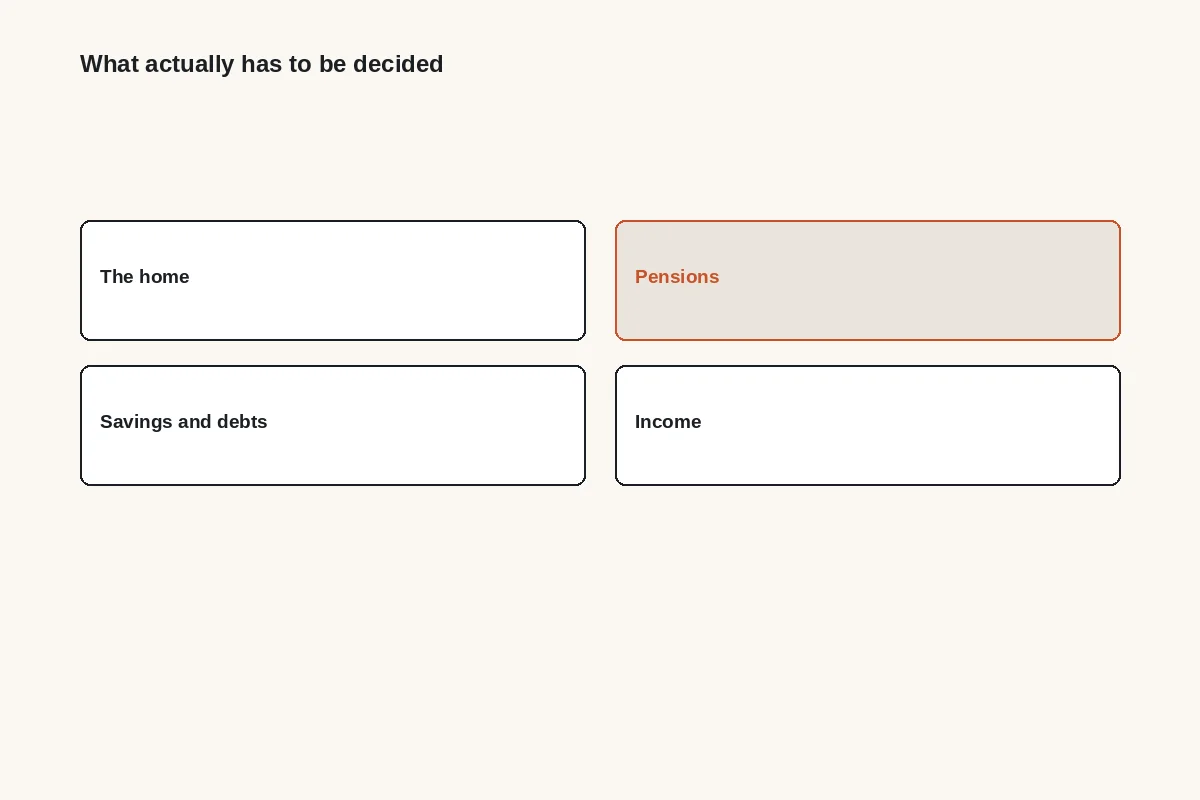
Divorce and separation mediation deals with everything that has to be settled when a relationship ends: the house, the pensions, the savings, the debts, the income, and where children are involved, the arrangements for them. It runs alongside the legal process of ending the marriage rather than replacing it, and the two move at different speeds.
Since April 2022, divorce in England and Wales no longer requires anyone to allege fault. The application itself is largely administrative and takes a minimum of twenty six weeks. What takes the time, and what actually determines how the next few years of your life look, is the financial settlement and the arrangements for the children. Those are what mediation is.
Disclosure comes first, and nothing useful happens before it

Both of you produce the same financial picture a court would require: income, property values, mortgage balances, savings, pensions, and debts. In court proceedings this is Form E. In mediation the same information is gathered in the same detail, because an offer made against a guess is an offer neither of you can rely on.
People sometimes want to skip ahead to proposals. It does not work. A settlement built on an estimate of a pension value falls apart when the real figure arrives, and by then both of you have spent weeks negotiating around a number that was never true.
The house

There are three realistic routes and which is available depends on borrowing capacity rather than on preference. Sell and divide the proceeds. One of you buys the other out. Or the sale is deferred, commonly until the youngest child finishes school, under what is generally called a Mesher order.
Whether a buy-out is possible is a lender's answer, not a mediator's. We suggest speaking to a broker before the session where the house is discussed, because the answer reshapes what is worth negotiating.
Pensions, which are usually the largest asset and the most often missed
A pension is frequently worth more than the equity in the family home. It is also the asset most commonly left out of an informal agreement, because it does not feel like money in the way a bank balance does.
The starting figure is the cash equivalent transfer value, and for a defined benefit scheme that figure routinely understates what the member is giving up. Where the sums are significant an actuarial report is money well spent, and we will say when we think you need one rather than presenting it as routine.
Three approaches exist. Pension sharing, where a percentage is transferred into the other party's name. Offsetting, where one party keeps more of another asset instead. And pension attachment, which is now rare. Each has consequences that differ by decades, and this is the part of a settlement where getting it wrong is least visible at the time.
Income, maintenance and the clean break

Child maintenance is calculated by the Child Maintenance Service using a formula based on the paying parent's gross income and the number of nights the children stay. You can agree a different figure between you, and many people do, but the formula is the fallback if agreement breaks down.
Spousal maintenance is separate and is not automatic. Where one party's income is much lower, it may be appropriate for a period. A clean break order ends all future financial claims between you, including on death, and it is what most people want if the circumstances allow it.
What you leave with
An open financial statement recording the disclosure, and a memorandum of understanding setting out the agreement. A solicitor turns those into a consent order, which is what makes the settlement final and enforceable. Without that order the agreement remains a private understanding, and a private understanding does not stop a future claim.
When mediation cannot do this
If you believe your ex-partner is hiding assets, mediation cannot compel disclosure and a court can. If there has been domestic abuse, mediation is not appropriate and an exemption applies. We would rather tell you that at the enquiry than take a fee for a process that was never going to work in your situation.
How mediation fits alongside the divorce itself
The divorce and the financial settlement are separate processes and they run on different clocks. The divorce application takes a minimum of twenty six weeks: twenty weeks before a conditional order can be applied for, then a further six weeks and a day before the final order.
Most solicitors will advise against applying for the final order until the financial settlement is sealed by the court. The reason is pensions. If one party dies after the final order but before a financial order is made, the survivor may lose widow or widower benefits that would have been payable had they still been married. It is an uncommon outcome and an irreversible one.
What a fair settlement means in practice
Section 25 of the Matrimonial Causes Act 1973 lists what a court considers: the income and earning capacity of each party, their financial needs and obligations, the standard of living during the marriage, the ages of the parties and the length of the marriage, any physical or mental disability, contributions made including caring for the home and family, and conduct where it would be inequitable to disregard it.
Equal division is a starting point in a long marriage, not a rule. Needs frequently take priority over equality, particularly where there are children and one party has the greater share of their care. A short marriage with no children and no shared assets is treated differently again.
Business interests
Where one party owns or part-owns a business, valuation becomes the central question and it is rarely simple. A trading company's value depends heavily on whether it could be sold at all and on how much of its value is the owner's own labour. A forensic accountant may be needed, and the cost of one is worth weighing against the sums in dispute.
The practical answer is usually that the business is not sold, and its value is offset against other assets instead. That keeps a functioning business intact and gives the other party something they can actually use.
Inheritance and pre-marital assets
Assets brought into the marriage or inherited during it are not automatically excluded, and people are often surprised by that. Whether they are ring-fenced depends largely on whether they were kept separate or mixed into the family finances, and on whether the other party's needs can be met without them. An inheritance used to buy the family home has generally lost its separate character.
Timescales you can plan around
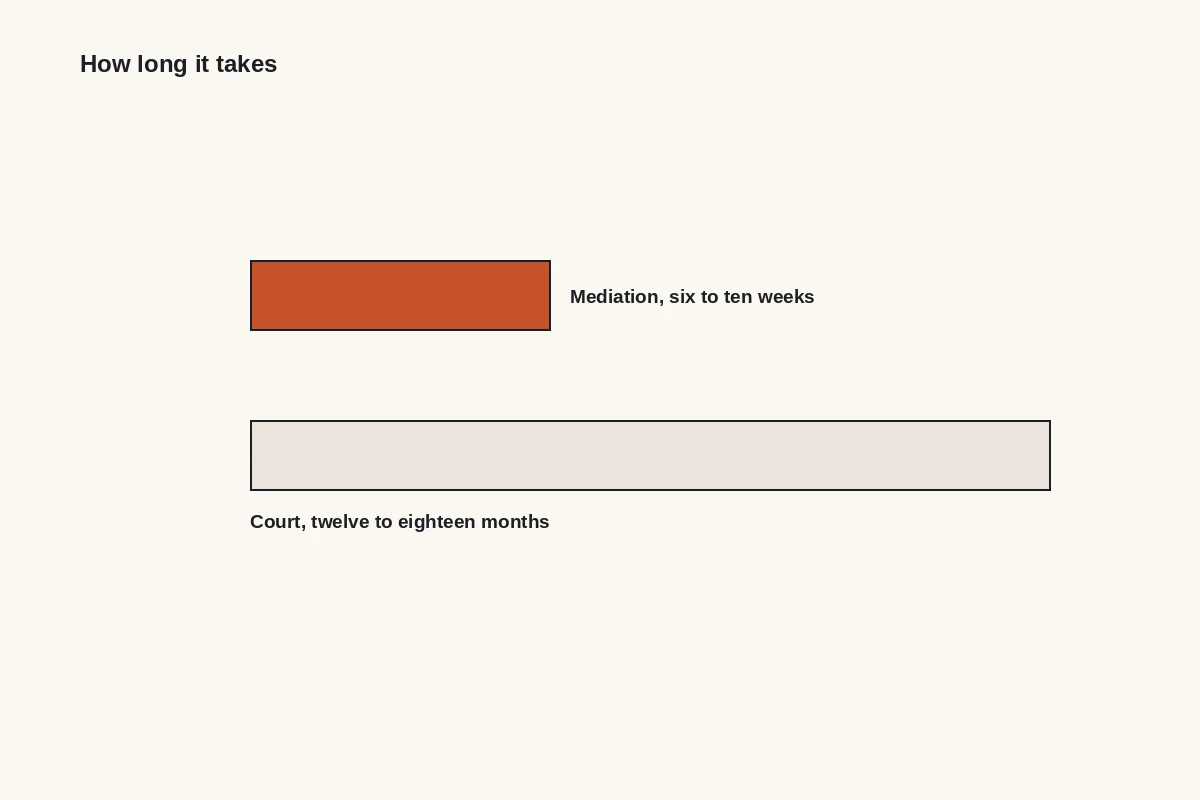
A financial settlement through mediation typically takes three to five sessions across two to four months, with most of the calendar time spent waiting for pension valuations rather than in the room. Requesting a cash equivalent transfer value at the start rather than when it is asked for is the single thing that most shortens the process.


 Face to face sessions
 Online and remote mediation
 Evening and weekend appointments