

What to say, what not to, and what children at different ages actually need to hear.
Before you tell them

Agree between you what you are going to say and answer the practical questions first. Children ask where they will live, which school they will go to, whether they still see the dog, and where their things will be. Not knowing is what frightens them, and answering with certainty is worth more than any reassurance about feelings.
You do not need a full settlement to do this. You need enough of a plan for the next few weeks.
Tell them together if you possibly can
Both parents, one conversation, the same words. It shows that the two of you can still act as their parents, which is the thing they most need to see. If a joint conversation is not possible, agree the wording in advance so that neither version contradicts the other. Children compare notes.
What to say
That the two of you have decided not to live together any more. That it is a decision between adults and it is not because of anything they did or said. That both of you love them and that will not change. Then the practical facts: where they will sleep, when they will see each other parent, what stays the same.
Say it is not their fault explicitly, and expect to say it again. Children of primary age routinely construct a private theory that a specific argument, or their own behaviour, caused it. It does not occur to them that the adults would not know this, so they do not mention it.
What not to say
The reasons. Whatever happened between the two of you is between the two of you, and a child who is given the detail is being asked to hold something they cannot do anything about. This includes detail delivered as a fact rather than a complaint.
Nothing that requires them to take a side, and nothing that invites them to comfort you. Do not promise things you cannot deliver, particularly about reconciliation or about a parent's future behaviour. And do not tell them just before school, at bedtime, or immediately before one of you leaves.
By age

Under five
Very short, very concrete, repeated often. Where they sleep and who collects them. They will ask the same question repeatedly for weeks, and answering it patiently each time is the work.
Five to ten
The age most likely to blame themselves and least likely to say so. Be explicit that it is not their fault, more than once. Keep routines identical wherever you can, because routine is how a child this age measures whether the world is still safe.
Eleven to fifteen
They will want reasons and may push for them. Hold the line without being cold: some things are between the adults, and that is a boundary rather than a rejection. Expect anger, and expect it aimed at whichever parent feels safer to be angry at, which is frequently the one doing more of the caring.
Sixteen and over
Old enough to be told more, and still not the right person to be told everything. The most common mistake with older teenagers is treating them as a confidant. They are still your child.
Afterwards
Tell the school. A form tutor who knows can interpret a change in behaviour correctly instead of treating it as a discipline matter, and most schools have pastoral support that is worth accepting.
Expect regression in younger children, sleep disruption, and a period of testing boundaries in both homes. Expect the conversation to reopen weeks later out of nowhere, usually in the car or at bedtime, which is when children raise difficult things because they do not have to make eye contact.
The thing that matters most
The research on this is consistent and it is worth knowing. What predicts poor outcomes for children of separated parents is not the separation. It is exposure to conflict between the parents afterwards: arguments they overhear, being used to carry messages, being asked questions about the other household, feeling they cannot mention one parent in front of the other.
Which is the strongest practical argument for resolving arrangements in mediation rather than through a contested court process. Not because it is cheaper or faster, though it is both, but because it lowers the conflict the children are living inside.
Agreeing the account first
Before anything is said, the two of you need one version. Children compare what they are told, sometimes immediately and sometimes years later, and two accounts that do not match teach a child that one parent is not telling the truth.
You do not need to agree about why the relationship ended. You need to agree what the children are told, which is a much smaller thing. A few sentences, written down, that you can both say without flinching.
Mediators help with this regularly, and it is frequently the first thing a separating couple manages to agree on. It is a reasonable use of part of a first session.
Timing
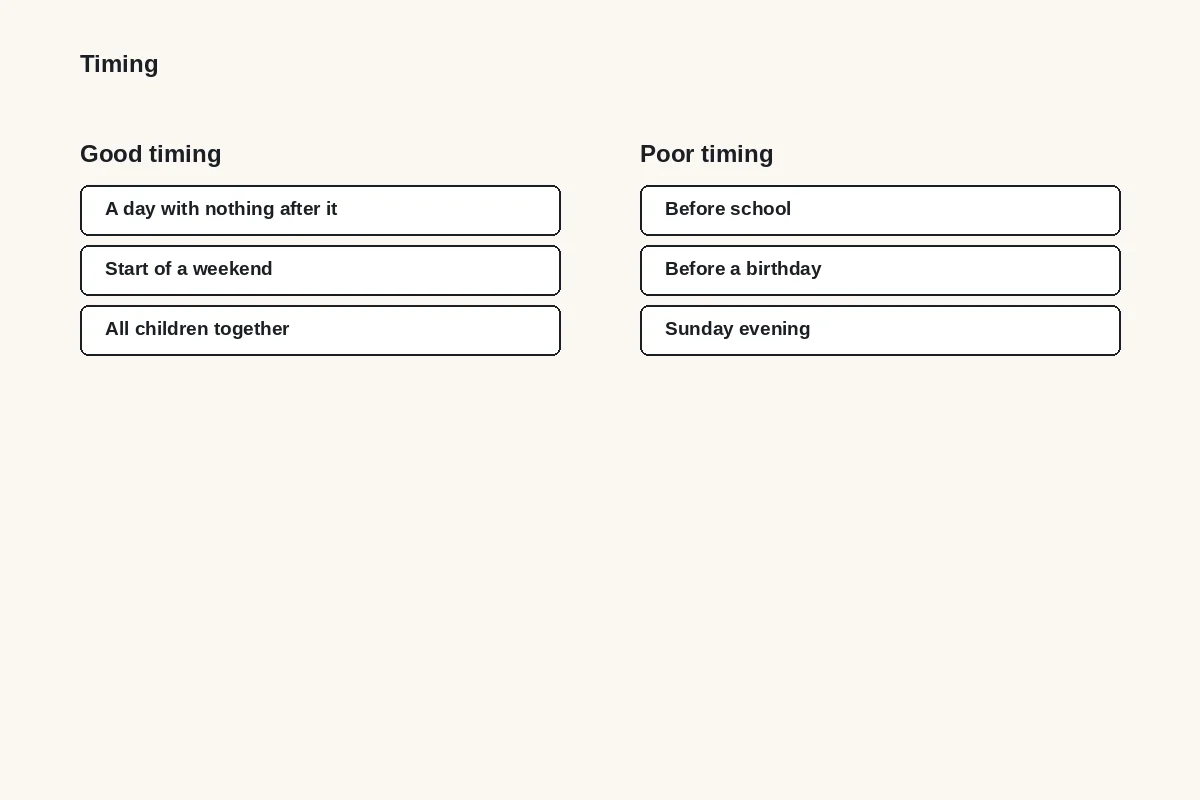
Tell them when you know something concrete, not when you are still deciding. A child told that things are uncertain lives in that uncertainty until it resolves, and children are far worse at tolerating it than adults.
Choose a day with nothing after it. Not before school, not before a birthday, not on a Sunday evening. A morning at the start of a weekend gives them two days of both parents being available.
Tell all the children at once where you can, then follow up with each of them individually. Told separately, the older one carries the secret until the younger one is told, which is a burden nobody meant to give them.
Being there together
Both parents present, if it is safe and possible. It demonstrates the thing you are about to tell them, which is that you are both still their parents and that this is something the two of you are managing rather than something one of you did.
Where that is not possible, and there are real situations where it is not, agree the words and each say the same ones.
The words themselves
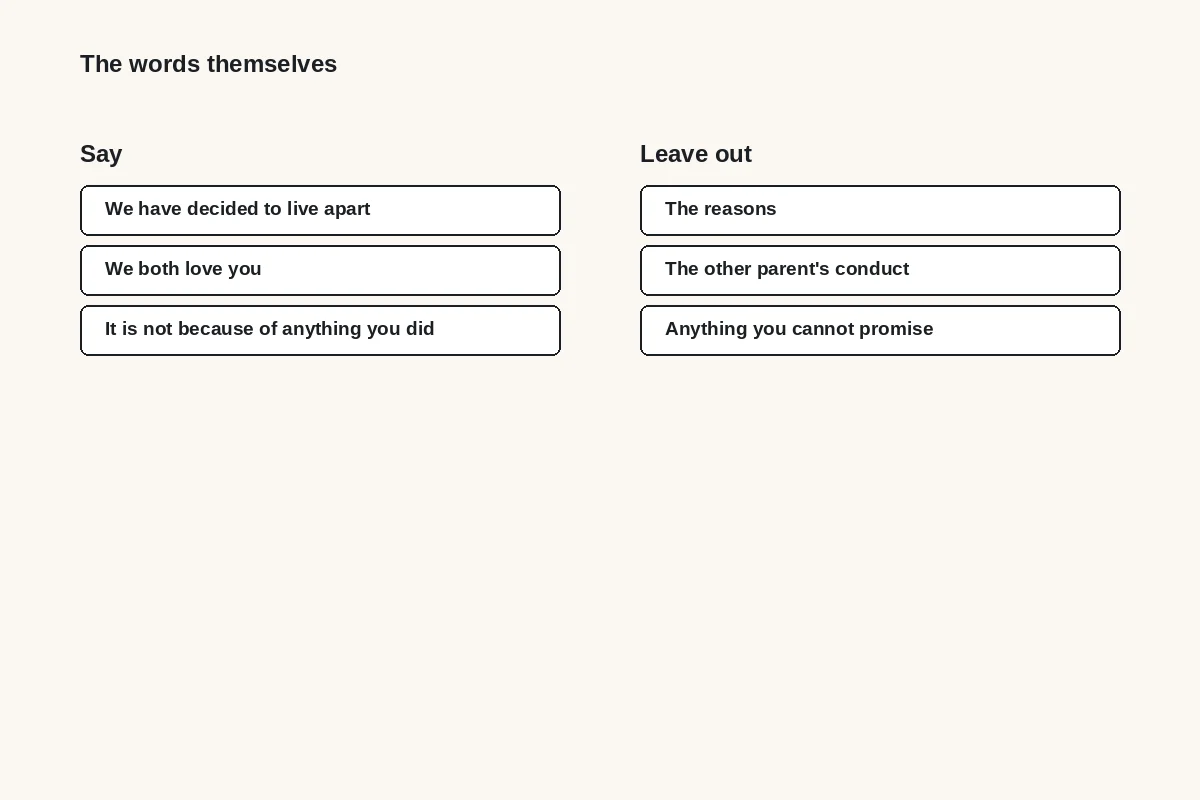
Short, clear, and in the past tense about the decision. That you have decided to live apart. That it is a decision the two of you made. That you both love them and that will not change. That it is not because of anything they did.
Then the practical facts, which is what they actually want. Where will I live. Where will you live. Do I change school. When do I see you. What happens to the dog.
Have real answers to as many of those as you can before you start. "We have not worked that out yet, and we will tell you as soon as we have" is an acceptable answer once. Repeated across every question, it makes the conversation frightening.
What to leave out
The reasons. Not because children cannot handle difficulty, but because the detail of an adult relationship is not theirs to hold and it invariably asks them to form a view about a parent.
Anything about the other parent's conduct. However true, and however much you want it said.
Anything that makes them a confidant. A child who becomes a parent's emotional support carries that role for years, and it is one of the most reliably damaging outcomes of a separation.
And any promise you cannot keep. "Nothing else will change" is almost always untrue, and a broken promise costs more than a difficult truth.
Age matters
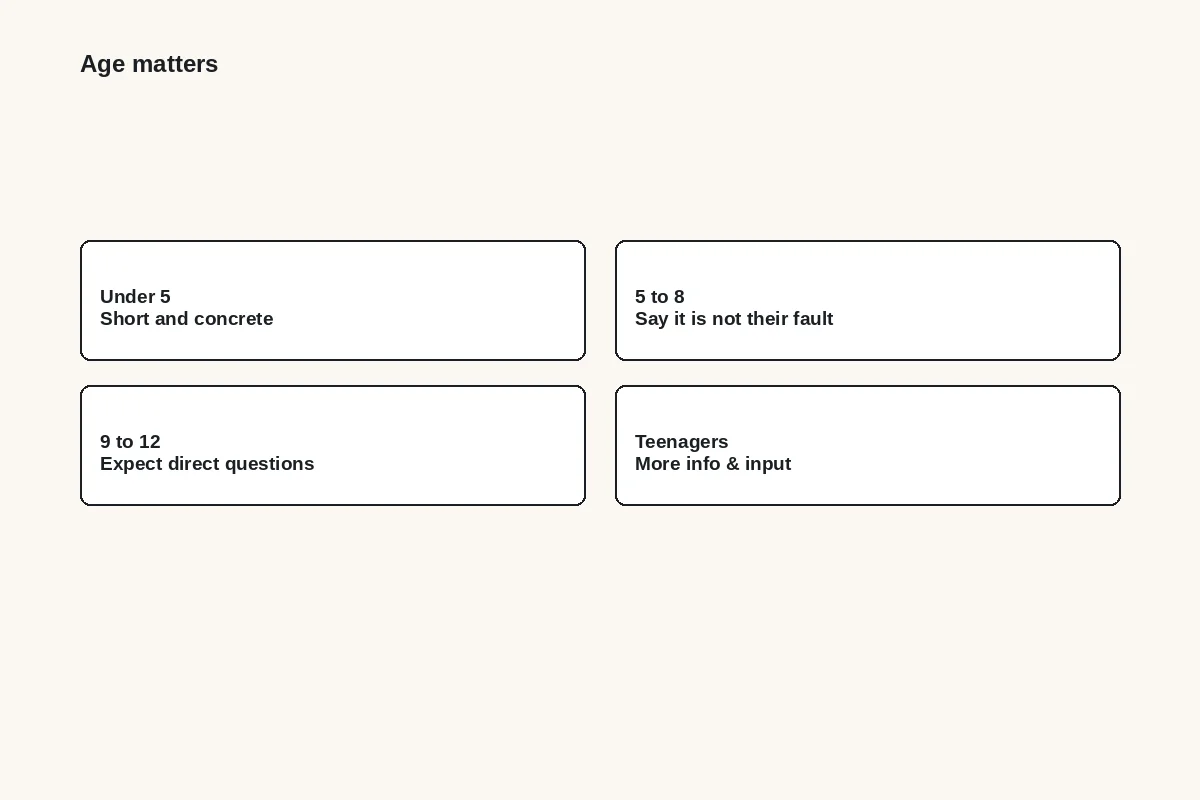
Under five: very short, very concrete, focused entirely on the practical. Two homes, two beds, both parents. Expect to repeat it many times, because young children process by asking again.
Five to eight: this is the age most prone to believing it is their fault, and it needs saying explicitly and more than once. Expect regression, some clinginess, and difficulty at school for a while.
Nine to twelve: they will ask direct questions and they will notice evasion. They may take sides, often the side of whichever parent seems more upset, and that alignment is not a judgement and usually does not last.
Teenagers: they may appear indifferent and are frequently not. They are more likely to be angry, more likely to want a say in the arrangements, and more likely to talk to friends than to either of you. Give them more information and more input, and do not mistake independence for not needing you.
What they are likely to do afterwards
Not much, immediately. A very common reaction is a short response and then a return to whatever they were doing. That is not indifference, it is a child taking it in at their own pace, and the questions arrive over the following days.
Expect sleep disruption, appetite changes, and behaviour at school. Tell the school what has happened. Teachers are used to it, they will watch for it, and it lets them read a change in behaviour correctly rather than as defiance.
Some children ask whether you might get back together. Answer honestly and kindly. Leaving room for a hope you know is not real prolongs the difficulty.
The months that follow
Keep the routine as intact as you can. School, activities, friendships, bedtime. Continuity in the ordinary parts of life does more than any conversation.
Do not make them a messenger. Not one message, not once, however convenient. Use email, a shared calendar or a co-parenting app, and keep the child out of it entirely.
Do not ask them to report on the other household. They will feel it as a test, and they will start managing what they tell each of you.
Speak neutrally about the other parent, especially when you do not feel neutral. Children hear criticism of a parent as criticism of half of themselves, and the research on this is unusually consistent.
When to get help
Persistent change lasting more than a couple of months, a marked withdrawal from friends, self harm, or a child taking on responsibility for a parent's wellbeing. Start with your GP, and ask the school what pastoral support they have, because many have more than parents realise.
Young Minds and Relate both offer support for children and families through separation, and neither requires a referral.
Getting help is not an admission that you handled it badly. Separation is genuinely hard for children even when the adults do everything well, and support is a reasonable response to a hard thing rather than a repair for a mistake.
How Mediation Direct can help in Hartlepool
Protecting your child's wellbeing through clear, cooperative co-parenting agreements and structured parenting plans.
Frequently Asked Questions About Our Services in Hartlepool
Should we tell them together?
Where possible, yes. It shows they still have two parents who can act together. If that is not possible, agree the wording in advance so the versions do not contradict.
How much detail should we give?
Enough to answer the practical questions and no more. The reasons between the adults are not information a child can do anything with.
What if they ask whose fault it is?
Say it is a decision between the adults and that neither of them needs to take a side. Answering with blame recruits them into the dispute.
When is the right time?
Not just before school, not at bedtime, and not immediately before one of you leaves. Ideally when there is a clear day or two afterwards to talk again.
They did not react at all. Is that a problem?
Not necessarily. Children often process later, and the conversation frequently reopens weeks afterwards. Leave the door visibly open.
Should we tell the school?
Yes. A teacher who knows can read a change in behaviour correctly rather than as a discipline issue, and pastoral support is worth accepting.
What if my ex-partner tells them a different version?
Correct the facts calmly without attacking the other account. Children who hear two contradictory stories usually stop asking, which is worse than either version.
Can a mediator help us plan this conversation?
Yes. Agreeing what will be said, and when, is a common and useful early session, and it is often the first thing two parents manage to agree on.
Should the children meet a new partner soon?
Most guidance suggests waiting until the relationship is established and the children have settled. Agreeing a timescale between you avoids it happening by accident.
What if a child asks to live with the other parent?
Listen without treating it as a verdict. It is usually about something specific and solvable, and reacting to it as rejection makes it harder for them to say the next thing.
About the author

Authored and reviewed by Family Mediation Council (FMC) accredited family mediators. Every procedural timeline and statutory requirement is verified against the Family Procedure Rules 2010 Part 3 and current Ministry of Justice standards.
- FMC Accredited
- Standards Board Registered
- Authorised MIAM Provider
- MoJ Voucher Scheme
Talk to someone who knows Hartlepool
No obligation, and nothing is decided on the call. We will talk through where you are and what your options actually are.